
45 degree buttweld elbow Applications in Piping






2026-10-13 10:25:11
The 45 degree buttweld elbow is among the most useful pipe fittings used in industrial piping systems. A full penetration circumferential weld diverts the flow of fluid 45 degrees, creating a permanent, pressure-rated junction. This fitting is manufactured as per ASME B16.9 and available in carbon steel, stainless steel, and alloy steel grades. It is utilised when a smoother directional shift is required with less pressure drop than a 90-degree turn. Engineers in oil and gas, electricity generation, and chemical processing use it every day.
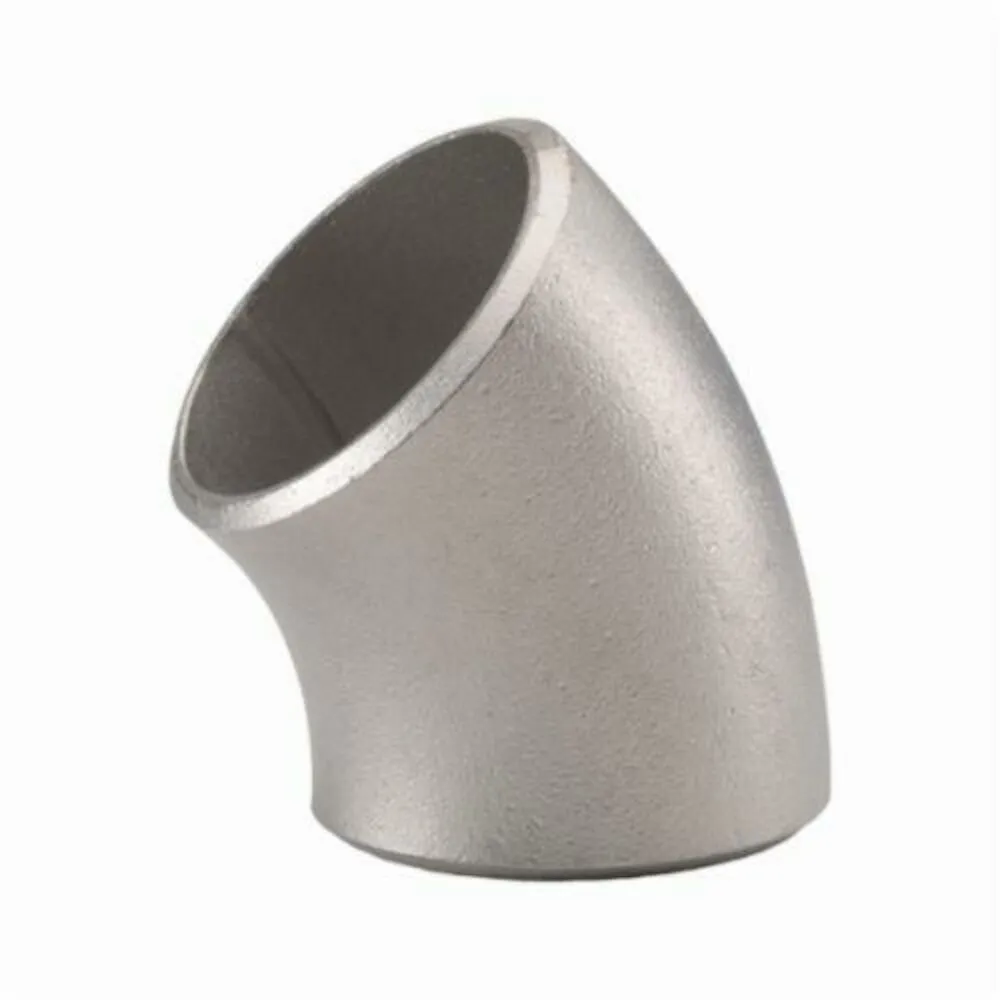
Understanding 45 Degree Buttweld Elbows: Technical Overview and Applications
What Defines a Buttweld Elbow?
A butt weld elbow is a steel junction formed by forging or hot pressing. The elbow is welded directly to the pipe at the beveled ends, which are typically cut at 37.5° per ASME B16.25. That creates a full-penetration weld that can provide strength comparable to the base material when the joint is properly designed, welded, and inspected. This eliminates the weak points typical of socket or threaded joints. It is a suitable option when the temperature and pressure levels exceed the capabilities of threaded joints.
Long Radius vs. Short Radius at 45 Degrees
An elbow of 45 degree butt weld is often referred to as Long Radius. This indicates that the distance from the center to the face is 1.5 times the nominal pipe size. The form provides a gradual change of direction, which can reduce turbulence and frictional losses compared with a sharper turn. Short Radius elbows are primarily standardized for 90-degree configurations, while 45-degree elbows are commonly supplied in long-radius configurations or other specified radii according to the applicable dimensional standard.
Key Industries That Specify This Fitting
It is utilised in water treatment facilities, petrochemical companies, oil and gas pipelines, steam generating systems, and food-grade process lines. On offshore platforms, riser and process piping may use 45-degree transitions instead of 90-degree turns when the layout, flow requirements, and piping stress conditions make the gradual change of direction advantageous. The progressive curvature used in power plant piping can help reduce local turbulence and erosion-corrosion effects in high-pressure steam lines, which can support more reliable operation where connection integrity is critical.
Dimensions, Measurement, and Installation of 45 Degree Buttweld Elbows
Standard Dimensional Reference
Dimensional agreement can't be negotiated for purchasing. ASME B16.9 Critical Dimensions: Nominal Pipe Size (NPS), Center-to-End distance (Dimension B), Outside Diameter at bevel, and Wall Thickness. JS FITTINGS provides sizes from 1/2" to 48" in SCH 10, SCH 40, and SCH 80 designs. The tolerance on the bevel root face is 1.6mm +/- 0.8 mm. This has a direct influence on weld quality and the results of the RT inspection.
Welding Methods and Joint Preparation
TIG welding is good for stainless steel and alloy grades in vital service applications, while MIG and manual shielded metal arc welding are more common for carbon steel lines. Each butt welded 45 pipe elbow has a 37.5° bevel within the applicable ASME B16.25 tolerance, which forms a clean V-groove to enable complete weld penetration and radiographic testing. The elbow schedule must match the schedule of the pipe to which it is fitted. If the schedules don't match, an internal bore step arises that might lead to turbulence and weld failure.
Comparing 45-Degree and 90-Degree Installation
For tighter layouts and lower pressure losses, a 45-degree fitting is better than a 90-degree elbow, which requires more room and creates higher pressure drop. A good 45-degree elbow will have great dimensional precision so that spool sections can be assembled without forcing them into alignment. This reduces rework time and maintains the weld integrity.
Selecting the Right 45 Degree Buttweld Elbow: Materials, Types, and Performance Criteria
Seamless vs. Welded Construction
Seamless elbows are manufactured without any longitudinal weld seam. This can make them suitable for certain high-pressure and high-temperature applications, such as sour gas lines or boiler piping, when the applicable material and design requirements are met. Welded elbows can be suitable for appropriate applications when the construction method, material specification, welding procedure, and required nondestructive examination meet the project requirements. They also save money on large diameters if seamless material is too costly or not available in time.
Carbon Steel, Stainless Steel, and Alloy Steel Options
The choice of material impacts performance and cost over time. Carbon steel is the best for general process and utility lines. Stainless steel grades offer good corrosion resistance in many process environments, with the appropriate grade depending on the chemical composition, temperature, and service conditions. Carbon steel strength and allowable stress decrease as temperature increases, so alloy steel grades such as ASTM A234 WP11 and WP22 may be employed for higher-temperature service when required by the design conditions.
Surface Coatings and Corrosion Protection
Carbon steel elbows are frequently painted with black paint or anti-rust oil or varnish to help prevent rust during transportation or storage. The fitting may need to be hot-dip galvanized, epoxy coated, or surface prepared so that it can be painted after welding, depending on the project demands. Selecting the correct surface treatment in advance can reduce rework costs and help protect the fitting until installation.
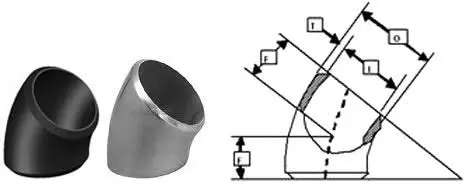
Top Considerations When Procuring 45 Degree Buttweld Elbows for Industrial Projects
Certifications and Material Documentation
As per EN 10204 3.1, every package of approved fittings, including a butt welded 45 pipe elbow, must include a Mill Test Report that confirms the chemical make-up, mechanical properties, and heat treatment status. Positive Material Identification with X-ray fluorescence makes sure that the chemistry matches the MTR for important services. JS FITTINGS has ISO 9001, CE, and GOST-R certifications and is a qualified supplier to ADNOC, NIOC, and Petrobras. This is important proof when sending vendor qualification packages for EPC or government contracts.
Quality Control Checkpoints
Before receiving a package, procurement teams should verify that the dimensions comply with ASME B16.9 and that the root face and bevel angle comply with ASME B16.25. Wall thickness should also remain within the specified dimensional and minimum-wall-thickness requirements across the bend, including the extrados. On the purchase order for critical lines, it should say that ultrasonic testing for wall lamination, magnetic particle inspection for surface cracks in carbon steel, and radial testing for welded-seam elbows must be done.
Supplier Credibility and Supply Chain Reliability
The rate of on-time deliveries and repurchases from a supplier are useful signs of supply chain health. JS FITTINGS keeps a repurchase rate of over 98% and an on-time delivery rate of over 95%. Each month, JS FITTINGS ships more than 90 containers and produces 800 tons of pipe fittings. This supply consistency directly protects profit margins and stops stock-outs that hurt relationships with end users for distributors and stockists who manage local inventory.
Enhancing Piping System Efficiency Using 45 Degree Buttweld Elbows: Practical Insights
Flow Performance and Pressure Drop Reduction
A 45-degree geometry generates substantially less of a pressure drop than a 90-degree geometry on the same line. This is particularly true in systems where high-viscosity fluids or gases are moved fast, and the operational expenses of operating the pumps pile up over time. The smooth interior bore and gentle curve further reduce the velocity of the abrasive particles hitting the wall. This immediately translates into a longer service life in maritime and refinery environments where erosion and corrosion cut down the time between inspections.
Uniform Wall Thickness and Structural Integrity
With controlled forming, wall thickness may be held to the dimensions and minimum-wall-thickness standards set across the bend, including the extrados. If the forming process is not well controlled, the extrados might be over-thinned. Poor forming control can create a locally weakened area that may compromise pressure integrity. The pressure capacity of the fitting should be determined according to the applicable dimensional, material, and design requirements when the fitting is within the scope of the governing piping code and fitting specification. It cuts out a typical weak link in the system.
Maintenance and Long-Term Service Life
During service, it is important to examine the extrados of stainless steel for erosion-corrosion thinning and the weld heat-affected zone for stress corrosion cracking. UT thickness surveys at multiple locations on the elbow are a practical way to check for wall-thickness loss. The geometry of a buttweld joint is usually more amenable to radiographic examination than some socket-weld configurations, which makes it easier to examine radiographically. This saves time and money on upkeep for the lifetime of the system.
Conclusion
The 45 degree buttweld elbow is a standard-compliant fitting that has been used for a long time and has been shown to solve real problems in industrial piping. It has a lower pressure drop, stronger weld joints, better inspection access, and a longer service life than other connection types. Getting the right material grade, schedule, and radius type for the job and getting from a seller that can back up every shipment with the right paperwork gets rid of the main sources of project risk. The detailed information in this guide makes it easy for engineers and buying teams to find and order the right fitting the first time.
FAQ
1. What is the difference between a 45-degree LR and SR buttweld elbow?
The Long Radius type, which has a radius of 1.5 × NPS, is a common configuration for 45-degree buttweld elbows. Short-radius elbows are primarily standardized for 90-degree configurations, while other radii for 45-degree elbows may be supplied according to the applicable dimensional requirements.
2. How do I match an elbow to my existing pipe?
Both the nominal pipe size and schedule should match the existing pipe. If the schedules differ, an internal bore step can form, creating turbulent flow conditions and potentially affecting weld integrity. Both dimensions should therefore be verified before placing an order.
3. Which material grade suits a corrosive service environment?
Against aggressive media, ASTM A403 WP316/316L stainless steel provides superior resistance to chloride-induced pitting and crevice corrosion compared to standard 304-series grades, although its suitability depends on chloride concentration, temperature, and service conditions. For sour-gas service at high temperatures and pressures, alloy steel grades such as ASTM A234 WP11 may be considered when they meet the applicable material, design, and sour-service requirements. The final material grade should be selected according to the specific corrosive medium, operating temperature, pressure, and applicable service requirements.
4. What documentation should I request with each order?
Ask for a Mill Test Report that confirms the chemical make-up, mechanical properties, and compliance with ASTM and ASME standards. For critical service applications, the purchase order should also specify PMI testing and any applicable NDT reports.
Partner with JS FITTINGS for Your 45 Degree Buttweld Elbow Supply
Since 1983, JS FITTINGS has been making and exporting pipe fittings. The company is certified by ISO 9001, CE, and GOST-R, and it is an approved 45 degree buttweld elbow provider to ADNOC, NIOC, and Petrobras. We ship more than 90 containers every month and have a complaint rate of less than 0.5% for sizes from 1/2" to 48" that meet ASME, DIN, JIS, and GOST standards. You can get a quote or send your specifications to admin@jsfittings.com, and someone will get back to you within an hour.
References
1. ASME B16.9 — Factory-Made Wrought Buttwelding Fittings, American Society of Mechanical Engineers, 2018.
2. ASTM A234 / A234M — Standard Specification for Piping Fittings of Wrought Carbon Steel and Alloy Steel for Moderate and High Temperature Service, ASTM International, 2022.
3. ASME B16.25 — Buttwelding Ends, American Society of Mechanical Engineers, 2017.
4. ASTM A403 / A403M — Standard Specification for Wrought Austenitic Stainless Steel Piping Fittings, ASTM International, 2021.
5. Nayyar, M. L. — Piping Handbook, 7th Edition, McGraw-Hill, 2000.
6. Becht, C. — Process Piping: The Complete Guide to ASME B31.3, ASME Press, 2009.
Send Inquiry
You may like