
All About ASTM A105 weld neck flange






2026-07-13 10:32:39
The ASTM A105 weld neck flange is a forged carbon steel pipe component that is designed to work in high-pressure and high-temperature industrial settings. This flange has a long, curved hub that butt-welds straight to the pipe. This effectively transfers mechanical stress from the flange to the connected pipe system. As long as safety, reliability, and compliance are the most important things, this part is the best flange for critical systems in oil and gas, petrochemical, power generation, and infrastructure projects. It meets ASME B16.5 size standards and ASTM A105 material standards.
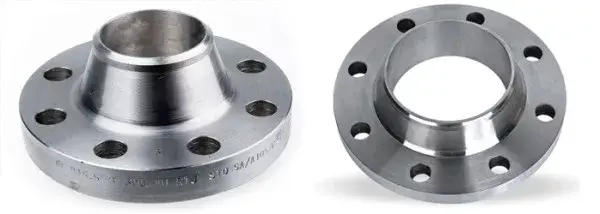
Understanding ASTM A105 Weld Neck Flange Specifications and Standards
Material Composition and Metallurgical Foundation
The ASTM A105 specification for carbon steel has a carefully controlled chemical makeup that affects how well it can be welded, machined, and maintained structurally. Manganese levels range from 0.60% to 1.05%, which refines the grain structure and makes the material tougher. The amount of phosphorus stays below 0.040%, and the amount of sulfur stays below 0.050%. This keeps the material from becoming too brittle and susceptible to cracking during welding. This specification for killed steel makes sure that the structure is always sound on the inside by reducing holes and separations in the forged structure.
Mechanical Properties That Define Performance
When purchasing managers look at forged flanges, the mechanical properties show if they can work in harsh conditions. A minimum tensile strength of 70,000 psi (485 MPa) is enough to hold enough weight under both internal and external forces. It has a yield strength of at least 36,000 psi (250 MPa), which means it won't deform during installation or normal use. The maximum allowable hardness is 187 Brinell Hardness, which is the right balance of strength and flexibility to keep things from breaking easily when they are hit or heated. All of these features make it suitable for a wide range of pressure and temperature conditions according to applicable ASME design requirements.
Dimensional Standards and Pressure Ratings
The dimensions for these forged components are set by ASME B16.5, which lists seven pressure classes: 150#, 300#, 400#, 600#, 900#, 1500#, and 2500#. Sizes range from NPS 1/2 to NPS 24 in basic layouts, and larger sizes may be supplied according to other applicable flange standards or customer requirements. The bore diameter is carefully machined to match certain pipe schedules, such as SCH 40, SCH 80, SCH 160, or XXS. This gets rid of internal diameter mismatches that cause erosion and turbulence. You can choose a Raised Face (RF) for gasket closing or a Ring Type Joint (RTJ) for high-pressure situations where metal-to-metal contact is needed.
Global Compliance and Certification Framework
For international projects, following more than just ASME and ASTM standards is necessary. ISO 9001 certification checks that quality management systems are in place, and CE marking makes sure that products meet European safety standards. Getting certified by GOST-R lets you sell in Russia and the CIS. Qualification by big energy companies like the National Iranian Oil Company, the Abu Dhabi National Oil Company, and Petrobras checks that the company can meet strict industry standards for manufacturing. These certifications mitigate procurement risks by ensuring consistent quality across production batches and making it easier to get goods through customs in a variety of regulatory settings.
Key Material Properties and Performance Characteristics
Structural Advantages of Forged Construction
Forging is what makes these flanges fundamentally different from cast alternatives. During hot forging, the grain flows in line with the shape of the part, making a continuous fiber structure that makes it stronger against impact and fatigue.This metallurgical advantage is critical in applications where the load changes over and over, like when the temperature rises, pressure changes, and vibrations cause stress patterns to repeat. The curved hub design makes the cross-sectional change smooth, which reduces the amount of stress at the weld joint and spreads mechanical loads evenly across the linked pipes.
Corrosion Resistance Profile and Limitations
In dry or slightly corrosive settings, ASTM A105 forged carbon steel flanges provide sufficient to corrosion, especially when protective coatings help reduce corrosion. But engineers need to be aware of the limits when the environment is chloride-rich, acidic, or humid, as these conditions speed up corrosion. When this happens, materials like ASTM A182 stainless steel or duplex metals are chosen. Carbon steel often provides a good cost-to-performance ratio for standard hydrocarbon service, water treatment facilities, and steam systems that work in moderate temperature ranges.
Material Comparison for Informed Selection
When choosing between carbon steel forged flanges and other options, buyers look at a number of factors. For low-temperature applications where A105 becomes brittle, ASTM A350 LF2 material is tough at low temperatures. Stainless steel grades (ASTM A182 F304/F316) don't rust, but they cost 200–300% more than other steel grades. For power production uses, alloy steels like A182 F5 or F9 can handle temperatures higher than 500°C. There is a balance between the original investment, the amount of upkeep needed, the operating lifespan, and the total cost of ownership over the lifetime of the project in the decision matrix.
Heat Treatment Impact on Longevity
Normalizing heat treatment smooths out the structure of the grains and releases any residual stresses from the forging process. This makes the material more stable and improves its mechanical properties. The right heat treatment cycles make it easier to weld by lowering changes in hardness and making it less likely that hydrogen will cause cracks. Manufacturers who maintain controlled furnace atmospheres and written records of heat treatment provide uniform product quality that can stand up to review by a third party and meet all project requirements without any changes.
Application Areas and Inspection Guidelines for ASTM A105 Weld Neck Flanges
Industry Sectors and Service Conditions
Forged flanges are used in wellhead systems, pipeline manifolds, and processing equipment in oil and gas production facilities where temperatures can reach 350°C and pressures are higher than 600 psi. Those are used by petrochemical plants to connect reactors, distillation columns, and transfer lines that deal with fuels that are aggressive. They are put in steam distribution networks, condensate return lines, and boiler feed systems by power plants. They are built into the infrastructure for treating water in high-pressure pump discharge lines and chemical injection points. Each use needs reliable sealing, structural stability, and the ability to work with current pipe configurations.
Environmental Suitability Assessment
Conditions in the environment affect how well materials work and how long they last. Installations near the coast are exposed to salt spray, so they need protective coatings or cathodic protection systems. For low-temperature services, impact testing may be required according to the applicable material and project requirements. Extreme temperature changes in desert climates make thermal fatigue worse. When choosing materials, it's important to take these environmental factors into account. Engineers can add extra standards during procurement to deal with problems that are unique to the place.
Visual and Dimensional Inspection Protocols
Quality control starts with looking at the surface to find flaws like surface defects, cracks, or laminations that weaken the structure. Checking the bore diameter, hub thickness, bolt hole spacing, and finish on the facing surface against engineering drawings and ASME B16.5 standards is called dimension verification. Calliper measures, height gauges, and coordinate measuring tools all provide objective proof that helps with tracking materials and proving compliance.
Non-Destructive Testing Methodologies
Radiographic testing (RT) checks the quality of the butt weld after it has been installed. It can show porosity, lack of fusion, or slag inclusions that can't be seen with the naked eye. When you use ultrasonic testing (UT), you can find flaws inside forged metal, like laminations or inclusions that make it less strong. Magnetic particle inspection (MPI) finds cracks on the surface and close to the surface of ferromagnetic materials. Liquid penetrant testing (PT) finds flaws that break the surface of non-magnetic materials or when MPI is not possible. Together, these NDT methods make sure that the product is sound before it is put under pressure. This stops catastrophic breakdowns that put people and property at risk.
Comparing ASTM A105 Weld Neck Flange with Alternatives for Informed Procurement
Carbon Steel Versus Stainless Steel Trade-offs
When projects need to stay within a budget, carbon steel flanges are preferred because they are cost-effective but may require additional corrosion protection. Alternate materials made of stainless steel offer corrosion resistance, but they are much more expensive. How much it costs to replace something and how long it is expected to last are all factors that affect the economic breakpoint. A 6-inch Class 300 carbon steel flange usually costs less than a stainless steel equivalent. This can save a lot of money on big projects with hundreds of connections.
Weld Neck Versus Slip-On Design Considerations
Slip-on flanges are easier to install and cost less at first, but they do not distribute stress as effectively as weld neck configurations. Slip-on designs need a double-fillet weld, which makes it harder to check for leaks and creates possible leak paths. Weld neck flanges are often preferred for higher pressure classes and cyclic loading conditions, where cyclic loading could damage the joint's integrity, because they are better at resisting fatigue. The single butt-weld connection makes inspection easier and allows full penetration that matches the strength of the pipe wall.
Pressure Class Selection Criteria
Based on the design pressure, temperature, and corrosion limit, engineering formulas figure out the right pressure class. A Class 150 flange can handle pressure ratings defined by ASME B16.5 according to material and temperature conditions. Class 300 provides higher allowable pressure ratings than Class 150 according to ASME B16.5 temperature-pressure tables, which is enough for most process uses. Classes 600 and up are used for high-pressure systems in power plants, offshore platforms, and certain chemical processes. Choosing pressure ratings that are too high raises costs without reason, while choosing ratings that are too low creates safety risks and regulatory noncompliance.
Heat Treatment Influence on Mechanical Strength
When heat-treated correctly, flanges have a finely tuned microstructure that makes them tougher and a regular spread of hardness. Manufacturers who follow written processes, use calibrated furnaces, and hire trained workers give goods that pass impact tests at the right temperatures. To make sure they are followed, procurement requirements should require mill test results that list the chemical makeup, mechanical properties, and heat treatment parameters.
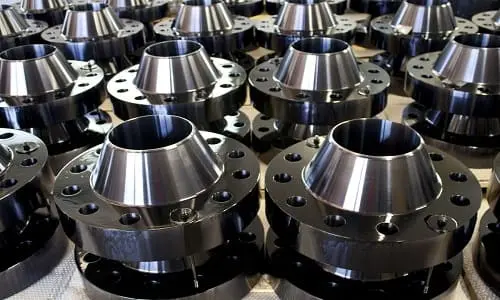
Procurement Guide: Buying ASTM A105 Weld Neck Flanges for B2B Clients
Supplier Qualification and Audit Considerations
The first step in reliable sourcing is to evaluate the supplier by looking at their manufacturing capabilities, quality systems, and industry certifications. ISO 9001 certification shows that you follow the rules for quality management, and ISO 14001 certification shows that you care about the environment. Facility audits check the state of production tools, the ability to inspect, and the skills of the workers. Supplier scorecards that keep track of things like on-time delivery, quality metrics, and responsiveness give you objective performance data that you can use to choose a vendor.
Commercial Terms and Lead Time Management
For common sizes and pressure classes, standard products from well-known manufacturers usually ship within two to four weeks. Lead times are extended to 6 to 8 weeks for custom configurations that need unique bore diameters, facings, or materials that aren't standard. Suppliers have different minimum order amounts. Some accept orders for just one piece, while others need at least ten pieces. Discounts for buying in bulk usually start at 50 pieces, with prices going down by 15 to 25 percent compared to small lot rates. For customs clearance, shipments must have exchange paperwork like mill test certificates, material traceability reports, and compliance declarations.
Quality Assessment Through Third-Party Verification
Independent inspection agencies check that a product meets all the requirements before it is shipped. Some of the services we offer are measuring, testing, nondestructive testing, and witness testing of mechanical properties. This extra layer of quality keeps buyers from getting goods that don't meet standards, which can slow down projects and cost more. Manufacturers with a good reputation welcome inspections by third parties because they see them as confirmation of their quality systems and not as an invasion of privacy.
Custom Solutions and OEM Partnerships
Manufacturers who offer custom machining, forged carbon steel weld neck flanges, special material grades, and application engineering support can help projects that have special needs. JS FITTINGS can work with sizes from DN15 to DN2000 (1/2" to 78") and can make more than 30,000 tons of products every year. Custom boring makes it possible to work with non-standard pipe schedules, and special facing configurations can be used to meet specific gasket needs. Engineering advice helps with choosing the right materials, making sure the pressure ratings are correct, and coming up with specifications that are in line with the project goals.
Conclusion
The ASTM A105 weld neck flange has been used in many difficult industrial settings and has been shown to work well by distributing stress evenly, maintaining structural integrity, and being easy to examine. When you know about material requirements, size standards, and buying factors, you can make smart choices that combine cost, performance, and legal needs. For most pressure piping systems, carbon steel forged construction is the most cost-effective option. Choosing the right supplier will also ensure consistent quality and on-time delivery. With its tapered hub design, precision-machined hole, and butt-weld connection, this flange is the best and most reliable choice for situations where failure would be unacceptable.
FAQ
1. What distinguishes ASTM A105 from stainless steel weld neck flanges?
ASTM A105 defines carbon steel as a material that is cost-effective and has good corrosion protection in settings that are not aggressive. Stainless steel grades (A182 F304/F316) are better at resisting corrosion, but they cost two to three times as much, so they should only be used when carbon steel doesn't work.
2. How can buyers verify ASME B16.5 compliance?
Ask for mill test results that list the chemical make-up, mechanical qualities, and measurements of material dimensions. Independent third-party inspection agencies check for conformance, and markings stamped on the faces of the flanges show the pressure class, material grade, and manufacturer.
3. What factors influence lead times for custom orders?
Delivery times are set by the availability of materials, the schedule for production, any special machining needs, and the scope of the inspection. Shipping times for standard requirements are usually 3–4 weeks, but for custom configurations that need to get materials and have special machines made, they can take up to 10 weeks, based on how complicated they are.
Partner With JS FITTINGS for Reliable Carbon Steel Forged Flanges
Every ASTM A105 weld neck flange that JS FITTINGS makes is backed by our more than 40 years of production experience. Our 7,000-square-meter warehouse ships more than 90 containers every month to customers in over 30 countries. We have a 98% return rate because we provide steady quality and quick service. As a qualified provider for big energy companies like NIOC, ADNOC, and Petrobras, we know how important it is to follow the rules, be able to track goods, and produce on time. Whether you need standard configurations or solutions that are specially designed to meet the needs of your project, our technical team will help you through the whole process of creating specifications and buying the products. Email us at admin@jsfittings.com to talk about your needs with an experienced ASTM A105 weld neck flange manufacturer who is committed to keeping your project as risk-free as possible while still meeting tight deadlines.
References
1. American Society of Mechanical Engineers (2020). ASME B16.5-2020: Pipe Flanges and Flanged Fittings NPS 1/2 Through NPS 24 Metric/Inch Standard. New York: ASME Press.
2. ASTM International (2021). ASTM A105/A105M-21: Standard Specification for Carbon Steel Forgings for Piping Applications. West Conshohocken: ASTM International.
3. Becht Engineering Company (2018). Flange Design and Analysis Handbook: Comprehensive Guide to Industrial Flange Systems. Houston: Technical Publications Division.
4. Nayyar, M.L. (2019). Piping Handbook, Eighth Edition. New York: McGraw-Hill Education.
5. Petroleum and Petrochemical Equipment Industry Association (2017). Technical Guidelines for Forged Steel Flanges in High-Pressure Service. Beijing: Standards Press of China.
6. Woodson, R.D. (2016). Piping Systems Manual: Design, Installation, and Maintenance. New York: McGraw-Hill Professional.
Send Inquiry

Related Industry Knowledge
- FBE vs 3LPE vs CWC for Underground and Subsea Applications
- What Is a Buttweld Bend? Types, Radius & Standards
- Slip-On Flange Uses and Applications
- Slip-On Flanges: Types, Uses, and Installation Guide
- Buttweld Tee Pressure Ratings Explained for Industrial Piping
- Why Is a Seamless Buttweld Tee Preferred in Critical Service?
- What is carbon steel pipe made of?
- Sch 40 Buttweld Reducer vs Sch 80 Pressure Performance
- What is a blind flange used for?
- What is a threaded flange?