
What Thread Standards Apply to Threaded Flanges?






2026-10-10 09:36:17
Threaded flanges—also called screwed flanges—feature an internal tapered thread machined directly into the bore, allowing direct connection to a pipe with matching external threads. No welding is required. The applicable thread standards that govern these components include ASME B1.20.1 for NPT threads, ISO 7-1 / EN 10226 for BSPT threads, and dimensional standards ASME B16.5 and DIN/EN 1092-1. Selecting the correct thread standard directly affects system integrity, pressure containment, and regulatory compliance—making this one of the first decisions any procurement or engineering team should get right.
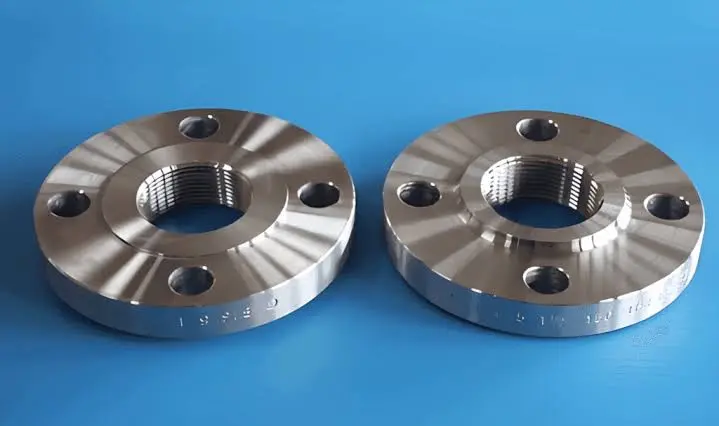
Understanding Threaded Flanges and Their Role in Piping Systems
What Makes a Threaded Flange Different?
A threaded flange, also called a screwed flange, connects to a pipe through mechanical thread engagement without requiring welding or heating during installation. The pipe is screwed into the flange until the specified thread engagement is reached. Threaded connections are the premier choice for small-bore utility lines, instrument connections, and hazardous operating environments where hot work permits cannot be issued.
Materials and Size Coverage
JS FITTINGS manufactures threaded flanges from alloy steel, low-temperature carbon steel, stainless steel, and carbon steel. The standard size ranges from ½" to 4", but bigger sizes are available for some low-pressure uses. ASME B16.5 covers Class 150, 300, 400, 600, 900, 1500, and 2500, with the available size range varying by pressure class.
How Do They Compare to Welded Connection Types?
Welded flanges, like weld neck and socket weld, are better at resisting bending moments and thermal cycling. Threaded connections, on the other hand, give up those structural benefits in exchange for being easier to put together quickly, not needing hot work permits, and allowing the connection to be disassembled without cutting. When it comes to total cost and ease of maintenance, screwed flanges can offer advantages over welded alternatives for utility lines, instrument connections, and fire protection headers that are exposed to room temperature.
The Core Thread Standards Applicable to Threaded Flanges
NPT — ASME B1.20.1
A 1 in 16 taper ratio is used for NPT threads. The thread shape makes an interference fit between parts that are meant to fit together, but the design leaves a small spiral leak path at the base and top of the thread. For a pressure-tight joint, you need a thread sealant like PTFE tape or anaerobic pipe dope. Dimensional tolerances, thread form, and the critical L1 standoff distance checked during quality inspection are all governed by ASME B1.20.1. Notably, NPT is the most common standard for screwed flanges sold in the United States.
BSPT — ISO 7-1 / EN 10226
BSPT threads use a 55° Whitworth thread form instead of NPT's 60° angle. NPT and BSPT threads are not directly interchangeable. Attempting to mate the two thread types can result in cross-threading, leakage, or thread damage. The sizes of BSPT threads are set by ISO 7-1 and EN 10226, which is its European equivalent. Customers can choose the right standard for their target market from a single source because JS FITTINGS sells both NPT and BSPT stainless steel pipe threaded flange products.
API and Specialty Thread Standards
In oil and gas applications, API 5B and API 6A apply to specific equipment and thread applications rather than standard plant-piping threaded flanges. API 5B covers certain casing, tubing, and line-pipe thread requirements, while API 6A covers wellhead and Christmas tree equipment. For most screwed flange uses in standard plant piping, ASME B1.20.1 and ISO 7-1 are commonly applicable. When API compliance is needed for a project, our expert team can make sure that the right material proof and dimensional package are provided.
Design and Dimensional Standards for Threaded Flanges
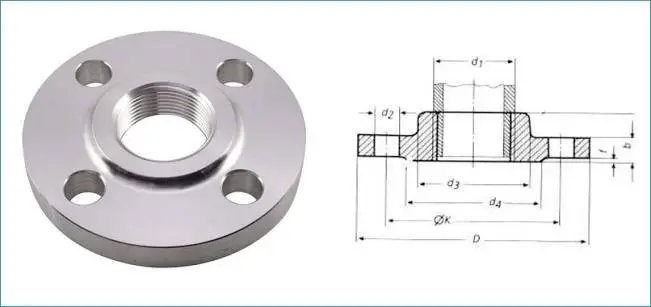
ASME B16.5 and DIN/EN 1092-1 Dimensional Requirements
ASME B16.5 specifies the sizes of threaded flanges in pressure classes 150 to 2500. These sizes include the bolt circle diameter, the raised face dimensions, and the overall thickness of the flange. EN 1092-1 provides European requirements for flange types, dimensions, and pressure designations. Both standards define various flange facing options, including Ring Type Joint, Flat Face, and Raised Face. RTJ facings are commonly selected for demanding high-pressure and high-temperature services where the applicable flange standard and project specification require them.
Material Standards and Certification
ASTM A182 specifies the chemical composition, tensile strength, and heat treatment needs for formed stainless and alloy steel flanges. Forgings made of carbon steel that will be used in normal and mild temperatures must follow ASTM A105. Every JS FITTINGS flange comes with a Mill Test Certificate that can be traced back to the forging heat. This traceability helps verify that the material conforms to the specified grade and supports the documentation requirements of B2B procurement programs.
Quality Control Protocols
Thread integrity is the most important part of QC for screwed flanges. To verify that thread taper and hand-tight engagement meet ASME B1.20.1, we inspect the L1 standoff dimension using precision-calibrated L1 taper thread plug gages.We also look for torn threads or chatter marks, verify the thread alignment and bolt-hole pattern, and use spectroscopic analysis for Positive Material Identification. Our quality control system is certified to ISO 9001:2015, supported by CE and GOST-R compliance, along with vendor approvals from leading global energy corporations including PETROBRAS and ADNOC.
Installation and Maintenance Best Practices
Sealing Methods and Torque Control
For NPT screwed flanges, PTFE tape applied in the direction of thread rotation is commonly used for sealing, while anaerobic pipe dope may be selected for higher-pressure service. Over-tightening can damage the thread flanks and create leak paths, while under-tightening may leave the spiral leak path insufficiently sealed. Following the applicable assembly procedure, manufacturer recommendations, and project-specific torque requirements can help prevent both types of failure. For important services, a trained inspector should verify the thread engagement and gauge position after assembly.
Limitations: When Not to Use Threaded Flanges?
ASME B31.3 states that threaded joints should be avoided in services where crevice corrosion, severe erosion, or cyclic loading may occur. Piping layouts should also minimize stress on threaded joints, particularly stresses caused by thermal expansion and valve operation. Under such severe operating conditions, threaded flanges are generally prohibited by design codes, and engineers should specify socket weld or weld neck flanges instead. The allowable size and pressure class of a threaded flange must be confirmed against the applicable flange standard, material, pipe schedule, and project design conditions. Higher pressure classes may impose additional requirements on the pipe wall thickness and external thread. Larger diameters can make it more difficult to achieve the required torque and thread engagement, while separation forces may also increase beyond what the threaded connection can reliably withstand.
Maintenance Access and System Modification
Disassembly is a useful benefit that procurement teams often forget about. A screwed flange can be removed without cutting, grinding, or other hot work, which can reduce maintenance downtime and avoid welding-related permit requirements in restricted areas. Over the service life of a facility, this can reduce maintenance costs, particularly in chemical processing plants and active refineries.
Making Informed Procurement Decisions
It takes more than looking at a price list to find the right screwed flange provider. Check to see if the supplier can provide proof that the dimensions meet ASME B16.5 or DIN/EN 1092-1 standards, that the threads are certified to ASME B1.20.1 or ISO 7-1, and that the material can be tracked through MTCs. Find a copy of their ISO 9001 scope and ask for PMI test results for the different alloy types.
When making a B2B purchasing choice, these are the things that mean the most:
- Thread standard match: Confirm NPT or BSPT against your project specification before ordering. Mixing standards on a single system creates an immediate leak risk.
- Pressure class and facing type: Specify the correct class and facing from the outset. Changing these after fabrication is costly.
- Material traceability: Require heat-traceable MTCs for every order. This protects your project during third-party inspections and client audits.
- Lead time realism: Stainless and alloy grades in higher pressure classes often require longer lead times. Confirm stock availability early to protect your project schedule.
If you always use these criteria, you can greatly lower the risk of buying and keep your project safe from needing expensive rework or inspection failures. Every month, JS FITTINGS makes 700 tons of flanges and delivers them on time 95% of the time or more, which helps projects that can't afford to be late.
Conclusion
It is necessary to follow thread standards for threaded flanges because they directly affect whether a screwed flange connection seals, holds pressure, and passes inspection. The U.S. market commonly uses NPT, while many European and international projects use BSPT or other thread standards specified by the applicable project requirements. The standards for size and pressure are ASME B16.5 or DIN/EN 1092-1, and the standards for material properties are ASTM A105, A182, or A350, depending on the service. Getting these specs to match up before you buy something protects project timelines, safety standards, and the total cost of ownership.
FAQ
1. Can I interchange NPT and BSPT threaded flanges on the same system?
No, BSPT has a 55° Whitworth form, and NPT has a 60° thread angle. They are not directly interchangeable. Forced assembly leads to cross-threading and a chance of leaks right away. Before you place an order, you should always make sure that the thread standard meets the needs of your project.
2. Are threaded flanges suitable for high-temperature cyclic service?
ASME B31.3 says that screwed connections shouldn't be used in places where there is a lot of thermal cycling or big bending moments. Differences in thermal expansion can make the threaded part loose over time, which can lead to leaks. For those situations, socket weld or weld neck flanges are the best choice.
3. What pressure classes are available for screwed flanges?
For Class 150, 300, 600, 900, 1500, and 2500, ASME B16.5 applies. The allowable size range for screwed flanges varies by pressure class and applicable standard. For higher pressure classes, the pipe schedule, thread engagement, material, and pressure-temperature rating must be checked against the applicable requirements.
4. How is thread quality verified before shipment?
Calibrated L1 taper thread plug gages are used to verify the pitch diameter and L1 standoff limits in accordance with ASME B1.20.1. Visual inspection checks for damaged threads and machining flaws, while PMI is used to confirm the material grade.
Partner with JS FITTINGS for Certified Threaded Flange Supply
Since 1983, JS FITTINGS has manufactured and exported industrial flanges to international markets, representing more than 40 years of production experience. Our threaded flanges are available with NPT and BSPT thread options across applicable pressure classes from Class 150 to 2500. As an approved manufacturer of threaded flanges recognized by PETROBRAS and ADNOC, we support EPC contractors, stockists, and industrial plant operators with verified on-time delivery and comprehensive quality documentation. Email our technical team at admin@jsfittings.com to get a quote or talk about the details of your project.
References
1. ASME B16.5 – Pipe Flanges and Flanged Fittings, American Society of Mechanical Engineers, 2017.
2. ASME B1.20.1 – Pipe Threads, General Purpose (Inch), American Society of Mechanical Engineers, 2013.
3. ASTM A182/A182M – Standard Specification for Forged or Rolled Alloy and Stainless Steel Pipe Flanges, ASTM International, 2023.
4. ISO 7-1 – Pipe Threads Where Pressure-Tight Joints Are Made on the Threads, International Organization for Standardization, 2022.
5. ASME B31.3 – Process Piping, American Society of Mechanical Engineers, 2022.
6. EN 1092-1 – Flanges and Their Joints: Circular Flanges for Pipes, Valves, Fittings and Accessories, European Committee for Standardization (CEN), 2018.
Send Inquiry
You may like