
90 degree buttweld elbow Dimensions and Pressure Ratings






2026-11-24 10:46:01
A 90 degree buttweld elbow is a factory-made wrought pipe fitting designed to change the direction of a piping system, typically by 90 degrees. It is connected to adjacent pipes through butt welding, creating a continuous welded joint. Its dimensions are specified by nominal pipe size, outside diameter, wall thickness (schedule), and center-to-end dimension, as covered by ASME B16.9. Its pressure capability is not expressed through a flange-style class. Instead, engineers evaluate it under the governing piping code, such as ASME B31.3, considering the material, wall thickness, design pressure, design temperature, corrosion allowance, and applicable fabrication and inspection requirements. In this guide, I explain how to read dimension tables, evaluate pressure limits, select materials, and prepare a clear inquiry so your order meets the project requirements.
What Is a 90 Degree Buttweld Elbow?
How a Butt Weld Elbow Works
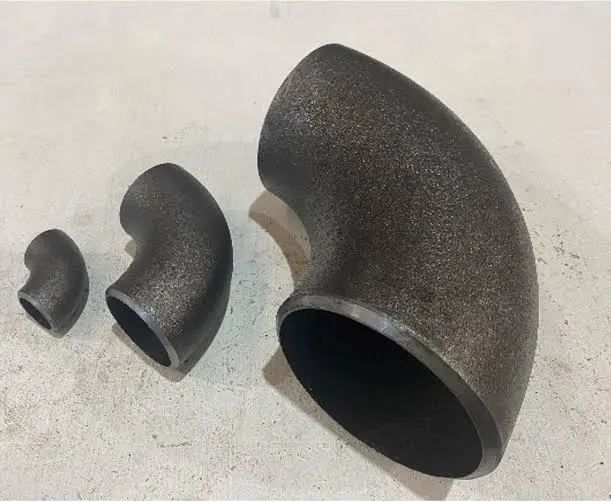
A 90-degree buttweld elbow is a factory-formed wrought steel fitting engineered for direct, full-penetration welded connection to adjacent piping spools. The ends of the pipe are aligned with the ends of the elbow and welded together to make a continuous connection. It is utilized often in industrial pipe systems where a right-angle change of direction is needed, as it alters the direction of flow by 90 degrees. Facilities operating under harsh pressure and temperature conditions, such as water treatment plants, power plants, oil and gas installations, and chemical processing plants, often use butt-weld connections.
Long Radius and Short Radius Types
The first thing to think about is the radius. A long radius (LR) elbow has a centerline radius of 1.5 times the nominal pipe size, while a short radius (SR) elbow has a centerline radius equal to the nominal pipe size. The wider radius of an LR elbow typically results in a smoother shift in flow direction and less pressure loss. An SR elbow needs less room to install, but it makes a sharper bend and usually results in more pressure loss. LR elbows are usually used when space allows, while SR elbows are suited for compact designs where piping design enables their use. Both types are used to connect pipes, pumps, valves, and other equipment at right angles.
Governing Standards You Should Know
Several standards are important when specifying a 90-degree butt-weld elbow. ASME B16.9 covers the dimensions, tolerances, ratings, testing, and marking requirements for factory-made wrought buttwelding fittings. ASME B16.25 specifies the preparation of welding ends, including bevel geometry and dimensional requirements. ASTM A234 covers wrought carbon steel and alloy steel piping fittings for moderate- and high-temperature service, while ASTM A403 covers wrought austenitic stainless steel piping fittings. Depending on the project requirements, other applicable standards may include MSS SP-75, DIN 2605, and JIS B2312. Always check the project specification to confirm the required standard and edition before placing an order. This helps prevent dimensional mismatches and rejection during inspection.
90 Degree Buttweld Elbow Dimensions Explained
The Dimensions You Must Verify
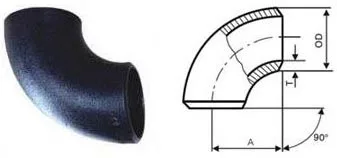
It's not enough to confirm that the elbow has the same nominal size as the pipe. You should check the NPS or DN, outside diameter, wall thickness or schedule, radius, center-to-end dimension, and weld-end bevel. For example, NPS 4 pipe has an outside diameter of 114.3 mm. Its Schedule 40 wall thickness is 6.02 mm, while its Schedule 80 wall thickness is 8.56 mm. Our butt weld 90 degree elbow range covers Schedule 10, 40, and 80, with sizes from 1/2" to 48". Our team can also review special dimensional requirements. The center-to-end dimension (A) is particularly important when fabricating pipe spools, connecting equipment, and replacing existing fittings. Even a small dimensional error can affect alignment and installation.
How to Read a Dimension Table
You can look at what size table we make before you place an order. In each row, read the following: NPS or DN, OD, wall thickness, center-to-end, radius, weight, material, and tolerance. ASME B16.9 numbers for 90-degree elbows are shown in the table below:
| NPS | OD (mm) | LR center-to-end (mm) | SR center-to-end (mm) |
|---|---|---|---|
| 2 | 60.3 | 76 | 51 |
| 4 | 114.3 | 152 | 102 |
| 6 | 168.3 | 229 | 152 |
| 8 | 219.1 | 305 | 203 |
| 12 | 323.9 | 457 | 305 |
These numbers should always be checked against the most current copy of ASME B16.9 and the order plan.
Common Reading Mistakes
Two common mistakes can cause problems during installation. The first is confusing nominal pipe size with actual outside diameter. For example, an NPS 4 pipe has an outside diameter of 114.3 mm, but this is not the elbow's center-to-end dimension. Under ASME B16.9, a standard NPS 4 90-degree LR elbow has a center-to-end dimension of approximately 152 mm, while an SR elbow measures approximately 102 mm. The second mistake is selecting the radius without checking the piping layout. An LR elbow may not fit in a restricted space, while an SR elbow may create a greater pressure drop. Use the ASME B16.9 tolerances to verify the outside diameter, wall thickness, center-to-end dimension, angle, and weld-end dimensions. For critical projects, request a dimensional inspection report before shipment.
90 Degree Buttweld Elbow Pressure Ratings
Why There Is No Flange-Style Class
Flanges are commonly designated by pressure classes such as Class 150, Class 300, and Class 600, but these designations do not represent fixed pressure limits in psi. A 90-degree butt-weld elbow does not use this flange-style class system. ASME B16.9 specifies the dimensions, tolerances, ratings, testing, and marking requirements for these fittings, while the applicable piping code determines the design pressure. The elbow's pressure capability depends on factors such as material, wall thickness, design temperature, and the applicable code requirements. At the same nominal pipe size, a Schedule 80 elbow generally has a thicker wall than a Schedule 40 elbow, but this alone does not establish its allowable working pressure. Applying a flange class directly to an elbow can lead to incorrect material selection and design assumptions.
What Sets Allowable Pressure
To determine the allowable pressure, engineers use the applicable piping code, typically ASME B31.3 for process piping or ASME B31.1 for power piping. The pressure-design calculations consider the pipe outside diameter, required wall thickness, allowable material stress at the design temperature, weld joint quality factors where applicable, and other code-specified factors. The calculation must also account for corrosion and erosion allowances, as well as applicable manufacturing tolerances. Because the allowable stress of steel generally decreases as temperature increases, a Schedule 40 elbow may have a lower allowable pressure at elevated temperatures than it does at ambient conditions. Engineers must also evaluate thermal expansion, cyclic loading, vibration, and external forces when designing the piping system.
Proof of Compliance
Inspection records and test documentation are helpful in showing that project criteria were satisfied. According to the specifications, customers may ask for material test certificates, dimensional inspection reports, and non-destructive examination (NDE) reports. The standard hydrostatic test pressure under ASME B31.3 is normally at least 1.5 times the design pressure, subject to the appropriate code rules and any necessary adjustment for the ratio of allowed stresses at design and test temperatures. JS FITTINGS uses a spectrometer and other inspection equipment to guarantee quality. The wall thickness of the elbow should also be checked dimensionally to ensure that it meets applicable manufacturing and design criteria, including the thickness at the extrados (outside curved area of the elbow) as required. Final acceptance shall be based on the governing code, project specification, and inspection results.
Choosing the Right Material and Comparing Options
Matching Material Grade to Service
Choose the material grade according to the design code, process fluid, operating temperature, pressure, and corrosion environment. ASTM A234 WPB carbon steel is commonly used in water, oil and gas, and general process piping systems where its mechanical properties and service-temperature limits are suitable. ASTM A403 grades 304/304L and 316/316L stainless steel offer better corrosion resistance in many applications. Grade 316/316L generally provides better resistance to chloride-related corrosion than 304/304L, although it may not be suitable for every seawater or high-chloride environment. Low-temperature carbon steel grades are selected for services requiring improved low-temperature toughness, while alloy steels such as chrome-moly grades may be specified for elevated-temperature service. Duplex stainless steel may also be considered for particular corrosive environments. Do not specify only "carbon steel" on your order. Include the exact material grade of the butt weld 90 degree elbow.
Seam or No Seam, and Elbow Angle
When comparing seamless versus welded elbows, you should consider the manufacturing method, material grade, size, design pressure, inspection requirements and project specification. Seamless Elbows are constructed without a longitudinal weld seam. Welded Elbows are formed from welded starting material or other specified fabrication procedures. The product must meet the appropriate standard and service requirements; neither type should be chosen only because of the way it is made. The piping architecture and hydraulic design also have a role in whether you choose a 90-degree elbow or two 45-degree elbows. Two 45-degree elbows can be used in some setups for a more progressive change in direction; however, this adds an extra fitting and weld joint. JS FITTINGS also provide 45-degree and 180-degree steel elbows.
Buttweld Versus Other Connections
Butt-welded connections are frequently utilized in piping systems that are subjected to high temperature, high pressure, cyclic loads and bigger diameters. Butt-weld joints are continuous and, if properly built, give a relatively smooth internal bore which can help eliminate flow disturbances at the joint. Threaded and socket weld connections may be viable for smaller bore pipelines depending on the design code and service conditions. LR elbows generally have lower pressure losses than SR elbows, because of the larger centerline radius.Pressure loss is directly governed by flow velocity and piping geometry. When selecting between Schedule 40 and Schedule 80, engineers must balance wall thickness, internal flow bore, component weight, and design pressure containment, ensuring that the elbow bore precisely matches the adjoining pipe to eliminate flow disturbances. Surface treatments vary with the material and operating environment. They may be oil-coated, epoxy-coated, painted black, or galvanized.
How to Select the Best 90 Degree Buttweld Elbow for an Industrial Project
Start with the Service Conditions
Start by defining the service conditions. Record the fluid or gas type, operating pressure and temperature, flow rate, potential corrosion or erosion risks, installation environment, and any cleaning or pigging requirements. Then specify the material, nominal size, schedule, elbow radius, NDE requirements, heat treatment, bevel preparation, and packaging. The 90 degree buttweld elbow must be compatible with the adjoining pipes, flanges, valves, tees, reducers, and prefabricated spools. EPC contractors and plant owners usually include these requirements in the project datasheet, while distributors and technicians should obtain the relevant information from their customers. A complete specification helps prevent errors during quotation, manufacturing, and installation.
Write a Complete RFQ
Providers can give you a correct quote the first time if you tell them everything they need to know. I believe you should add this:
- Product and size: Specify the quantity, NPS or DN, outside diameter, schedule, radius (LR or SR), angle, and weld-end bevel requirements. Provide a technical drawing when available so the supplier can verify the dimensions and confirm compatibility with the connecting pipe.
- Material and standard: Material grade, manufacturing standard such as ASME B16.9, construction type, service medium, and design pressure and temperature. A full material description prevents substitutions and tells the supplier which heat treatment, testing, and certificates apply to your order.
- Inspection and delivery: Inspection and NDE requirements, packaging, destination, Incoterms, delivery date, and any OEM or private-label marking. Clear terms help the supplier plan production and shipping, and they let you compare quotations on more than just price per unit.
Avoid Common Buying Problems
Incomplete specifications are a common cause of purchasing and installation problems. Buyers may specify only the nominal size, confuse flange pressure classes with elbow design requirements, select an unsuitable material grade, overlook weld-end bevel compatibility, or choose an SR elbow when the layout requires an LR design. Missing heat numbers, material test certificates, dimensional inspection reports, and NDE records can also complicate project acceptance and traceability. A low initial quotation may not reflect the full cost of delayed delivery, non-compliant documentation, dimensional deviations, or replacement work. Compare suppliers based on total cost of ownership, lead time, compliance, traceability, and shipping arrangements rather than unit price alone.
Judge the Supplier
JS FITTINGS has been manufacturing and supplying pipe fittings to customers in international markets since 1983. We can offer standard diameters ranging from DN15 to DN1200. For bigger or non-standard sizes, these are available pending drawing review and production feasibility. We can also consider bespoke specifications for each project. Our production process incorporates controlled shaping and dimensional inspection to assist maintain consistent interior profiles and product dimensions. Weld-end bevel preparation is done according to the relevant standard, project specification and authorized welding criteria. JS FITTINGS has quality management and product documentation for customers to analyze and inspect projects. We maintain a verified on-time delivery rate exceeding 95%, supported by optimized production scheduling and dedicated export logistics. We can also consider sample orders and small batch trial purchases.
Conclusion
The project specification and ASME B16.9 requirements should be checked before selecting a 90 degree buttweld elbow. Buyers need to confirm the nominal size, actual outside diameter, pipe schedule, radius, and center-to-end dimension. Unlike flanges, butt-weld elbows do not use a flange-style pressure class. Their pressure design must be evaluated under the applicable piping code, such as ASME B31.3, based on material properties, wall thickness, design temperature, and corrosion allowance. LR and SR elbows also have different space requirements and flow characteristics, so the correct type should be selected according to the piping layout and hydraulic design. Complete technical specifications, material certificates, dimensional reports, and inspection records help reduce purchasing errors, installation delays, and compliance risks.
FAQ
1. What is the standard for 90 degree butt-weld elbow dimensions?
The sizes and error levels for wrought butt-welding parts manufactured in a workshop are listed in ASME B16.9. ASME B16.25 tells you how to prepare the weld end and gives you the bevel angle.
2. What is the center-to-end dimension?
The center-to-end dimension is the distance from the intersection of the elbow centerline to the plane of the weld end. For a normal 90-degree LR elbow, its dimension is usually 1.5 times the nominal pipe size. For an SR elbow, it is mostly the same as the nominal pipe size. Always refer to the corresponding ASME B16.9 table for the exact dimension.
3. Is there a standard pressure rating for a Schedule 80 elbow?
No. There is no uniform pressure rating for a Schedule 80 elbow. The permissible pressure is a function of the material grade, the design temperature, the pipe code used, the actual wall thickness, and corrosion allowance. Schedule 80 typically has a thicker wall than Schedule 40 for the same nominal pipe size; however, the final pressure design must still be confirmed by the appropriate engineering calculations.
4. When should I use LR rather than SR?
LR elbows are normally preferable when enough room is available for installation because their greater radius generally gives lesser pressure loss. SR Elbows are suited for small pipe layouts when space is restricted, and the higher pressure loss is acceptable for the system design requirements.
5. Can I order bespoke sizes?
Yes. JS FITTINGS manufactures one-of-a-kind items particularly for you and conducts OEM work.If you have an engineering drawing, isometric, or fabrication data sheet, please attach it with your inquiry.
Contact JS FITTINGS for Your 90 Degree Buttweld Elbow Quote
We'll try to get back to you in an hour if you email admin@jsfittings.com with your size, plan, material grade, radius, standard, number, and address. Standard or custom 90 degree buttweld elbows with inspection papers can be provided by JS FITTINGS, a provider with ISO 9001 quality control and help with sample and small-batch trial orders.
References
1. ASME B16.9 Factory-Made Wrought Buttwelding Fittings, 2018
2. ASME B16.25 Buttwelding Ends, 2017
3. ASME B31.3 Process Piping, 2022
4. ASTM A234/A234M Standard Specification for Piping Fittings of Wrought Carbon Steel and Alloy Steel for Moderate and High Temperature Service, 2019
5. ASTM A403/A403M Standard Specification for Wrought Austenitic Stainless Steel Piping Fittings, 2016
6. Piping Handbook, 7th Edition, McGraw-Hill, 2000
Send Inquiry
You may like
Related Industry Knowledge
- RTJ Blind Flange vs RF Blind Flange: Key Differences
- When Is a Plate Flange the Best Choice?
- Can Threaded Flanges Handle High Pressure?
- Stainless Steel vs Carbon Steel Buttweld Reducer Comparison
- Carbon Steel Buttweld Tee vs Stainless Steel Performance
- How Does a Buttweld Tee Improve Flow Distribution Systems?
- Custom Stainless Steel Buttweld Elbow for Chemical Plants
- Class 150 Flat Face (FF) Forged Steel Flange for Water Service
- How long does A53 ERW Pipe last?
- Carbon Steel Forged Steel Flange: Class 150 to 2500 Guide