
Buttweld Tee Weight Chart and Thickness Standards Guide






2026-11-10 09:34:30
A buttweld tee is a three-way pipe fitting used to connect adjacent pipes with butt welds and is dimensioned in accordance with ASME B16.9. Wall thickness, with designation of a Schedule (SCH 10S through XXS), directly influences weight and pressure capability, while design pressure ratings also depend on material, temperature, and applicable code. Choosing the proper schedule & material grade – carbon steel ASTM A234 WPB or stainless ASTM A403 WP316L – helps avoid expensive over-specification and field failures. This document provides procurement engineers with weight charts, thickness standards, and inspection methods to enable informed sourcing selections.
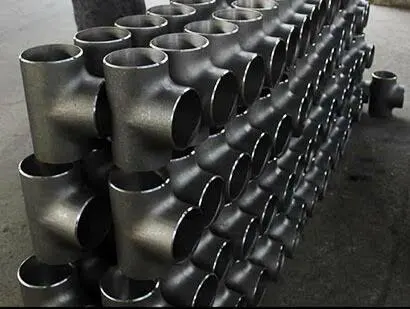
Understanding Buttweld Tee Dimensions and Weight Standards
Any pipe specification starts with accurate dimensions data. Before you look at weight tables, it might be helpful to understand how size, type, and wall thickness interact.
Defining Equal Tees and Reducing Tees
An equal tee is a three-way fitting with the same nominal pipe size (NPS) on all three ends. A reduction tee has a smaller branch output. This is utilized when joining a main header to a smaller process line. Both are sized per ASME B16.9 and have center-to-end lengths determined by NPS, supporting dimensional interchangeability when the same size and specification are used.
How Wall Thickness Affects Fitting Weight
Fitting weight is mainly determined by wall thickness Schedule – SCH 10S, 40, 80, 160, or XXS. For example, a 6-inch equal tee in carbon steel, SCH 40 weighs about 13.6 kg, and a similar size in SCH 160 weighs approx. 32.5 kg. Heavier fittings can provide greater pressure capability when the design and material are otherwise comparable, but they also increase material prices and weld prep time,making accurate schedule optimization a critical cost-saving strategy on large-scale capital projects.
Reading a Buttweld Tee Weight Chart
Standard weight tables provide weight in kilograms or pounds against NPS and Schedule. JS FITTINGS provides seamless tees from 1/2" to 24" (DN15 to DN600) and welded tees from 24" to 72" (DN600 to DN1800), for all the usual project requirements. Cross-referencing the NPS column with the Schedule row reveals the unit weight. This is used by procurement teams to compute the shipping costs and to check that the heat figures and dimensions are consistent on the supplier’s mill certificates.
Thickness Standards and Material Specifications for Buttweld Tees
The correct wall thickness comes from the right material. Together they describe the performance of a fitting under pressure, temperature, and corrosive media.
ASME B16.9 and Schedule Classifications
The controlling dimensional standard is ASME B16.9. It does not specify wall thickness by itself, but requires the fitting to follow the schedule of the mating pipe. STD (standard) is generally equivalent to SCH 40 up to 10" pipe size. XS (extra strong) is generally equivalent to SCH 80 for smaller NPS, but schedule equivalences change with pipe size. XXS is a heavier-wall designation and is not simply twice the wall thickness of XS. Procurement papers should always include both the NPS and the schedule to avoid any misinterpretation.
Material Grades and Their Impact on Weight
Material selection influences the weight-to-strength ratio and the appropriate schedule range. JS FITTINGS has the following main grades:
- ASTM A234 WPB/WPC (Carbon Steel): These are common options for moderate- and high-temperature service; the allowable temperature depends on the applicable design code and material condition. Available in SCH 10 to XXS.
- ASTM A420 WPL6 (Low Temperature Steel): Suitable for cryogenic and Arctic operation; Charpy V-notch impact testing is required.
- ASTM A403 WP304/L, WP316/L, WP321, WP347 (Stainless Steel): Higher chromium and nickel content provides corrosion resistance; density is generally only slightly above that of carbon steel, so unit weight is typically only a few percent higher.
- ASTM A234 WP11, WP22, WP91 (Chrome-Moly Alloy): Commonly used for high-temperature power plant and steam service.
Choosing the right grade at the beginning of the acquisition avoids material substitution problems during third-party inspection.
Crotch Thickness: The Hidden Safety Factor
The maximum stress concentration in each buttweld tee occurs in the crotch, the inner curve where the run meets the branch. The crotch zone is thinned via hydraulic bulging or hot-extrusion formation. JS FITTINGS provides additional wall thickness in this location throughout the manufacturing process to meet and surpass ASME B16.9 minimum criteria. Heat treatment is performed as required by the applicable material specification and manufacturing route to restore the required mechanical properties and control residual stresses.
How to Use Buttweld Tee Weight and Thickness Charts for Procurement Decisions
Weight and thickness charts are useful tools, not just documents to look at. If you use them right, they can help you stick to your project schedule and budget.
Matching Schedule to Application
For high-pressure service, oil and gas process lines may require SCH 80 or above depending on the design conditions. It is more economical and safer to select the schedule from the applicable design calculation rather than use a blanket schedule. Often, water treatment and HVAC usage employ SCH 40 or SCH 10S. When the fitting and the mating pipe have different internal diameters, a bore step can be formed, which may increase local turbulence and erosion risk. The significance of the mismatch depends on flow conditions and the piping design.
Calculating Project Quantities and Costs
Multiply the chart’s unit weight by the number of parts to obtain the raw weight. Then multiply by the current price of steel per kilogram. This offers a good basis for material costs to bid on. Order OEM bulk quantities with JS FITTINGS and receive volume pricing and priority production scheduling to help you fulfill tight project deadlines. The mill produces 800 tons of pipe fittings each month; hence, supply consistency is not a concern, even for large EPC projects.
Verifying Supplier Compliance Before Purchase
Always request the mill test report (MTR) and ensure the heat number on the report matches the number imprinted on each fitting. Each item of JS FITTINGS is traceable by heat number, material grade, and size. This allows procurement teams to trace each unit back to the mill that produced the raw materials,a prerequisite for approved supplier audits by major international energy operators like ADNOC and Petrobras.
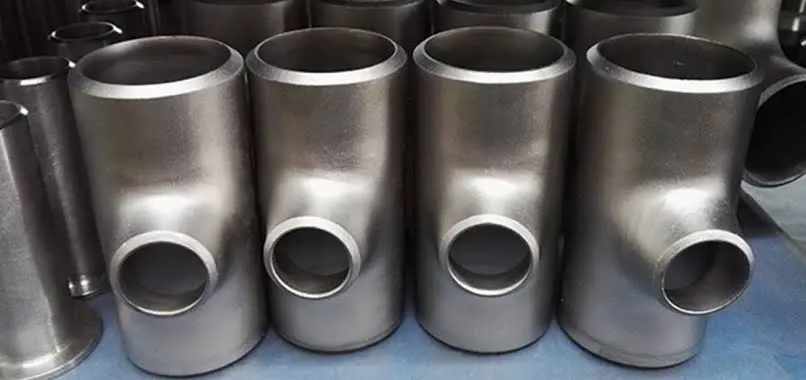
Comparing Buttweld Tee Types and Standards: Making the Right Choice
You can't just switch out any T-fitting. Knowing the differences can help you stay away from design mistakes that lead to extra work or inspection rejects.
Buttweld vs. Socket Weld Fittings
When butt welded, the junction is as strong in tension as the pipe itself, since the weld runs all the way through the wall. Socket weld fittings utilize an external fillet weld around the hub of the socket, which creates a sharp stress concentration at the weld toe. ASME B16.11 covers socket-welding fittings up to NPS 4 for the applicable fitting types and pressure classes. They are also less suitable for high-vibration lines such as compressor discharge unless the fatigue and piping design are specifically assessed.
Seamless vs. Welded Tees
Seamless buttweld tees are created without a longitudinal weld seam. This can make them attractive for critical-duty or high-pressure applications, although suitability still depends on the material, design conditions, and project specification. Welded tees can be produced from plate or welded tubular material for large diameters up to 72" when seamless manufacture is not practicable. JS FITTINGS performs radiography (RT) and liquid penetrant (PT) checks on all welded tees in important service for any weld cracks.
Forged vs. Cast Tees
ASME B16.9 covers factory-made wrought buttwelding fittings, which may be manufactured by different forming processes rather than being exclusively forged. Forged fittings can provide a refined grain structure, but impact resistance depends on the material and heat treatment. ASTM A234 and A403 specify wrought fittings, so cast fittings are covered by different material specifications. Many EPC projects specify wrought buttweld fittings for process piping.
Inspection and Quality Assurance of Buttweld Tees Based on Weight and Thickness
You can't skip the step of quality testing. When a fitting fails a material or size check, it causes delays that cost a lot more than the fitting itself.
Dimensional and Bevel Verification
Inspectors check that the measurements from center to end are in line with ASME B16.9, that the root face is approximately 1.5 mm with the applicable tolerance, and the bevel angle is 37.5° ± 2.5°. At JS FITTINGS, CNC beveling machines make bevels with consistent shapes. This cuts down on the time needed for fit-up on-site and lowers the risk of weld defects.
NDT Methods in Practice
Three NDT methods meet most buying needs:
- Ultrasonic Testing (UT): Checks wall thickness uniformity and detects lamination in the forming zone.
- Magnetic Particle Inspection (MPI): Reveals surface cracks or die marks after forming.
- Radiographic Testing (RT): May be required by the applicable material specification, project specification, or purchaser for welded tees; JS FITTINGS offers 100% X-ray coverage on request.
When these tests are combined with positive material identification (PMI) using an XRF analyzer, they can verify many alloying elements against the declared grade. Because handheld XRF does not reliably measure carbon, additional chemical analysis may be needed to fully distinguish some grades. This reduces the risk of material mix-up.
Certifications That Back the Product
The company JS FITTINGS is certified to ISO 9001 and has CE and GOST-R marks on its products. The factory is an approved supplier for leading global energy corporations including ADNOC and Petrobras. This means that its quality management system has passed audits from outside the energy sector. Every shipment comes with approved mill test reports and a full document package for buying teams that are sending in bid papers.
Conclusion
If you want to pick the proper pipe buttweld tee, you need to make three choices: the right NPS and Schedule from the weight chart, the right material grade for the work, and a supplier that has a quality system that can prove compliance at each checkpoint. When those three factors come together, long-term performance is improved, and project risk is reduced. For over 40 years, JS FITTINGS has been serving EPC contractors, distributors, and industrial end customers in more than 30 countries. They are accredited in their manufacturing, follow stringent NDT processes, and can track their materials entirely.
FAQ
1. What is the difference between STD, XS, and XXS wall thickness?
STD generally corresponds to SCH 40 up to NPS 10, while schedule equivalences vary at larger sizes. XS is generally equivalent to SCH 80 for smaller NPS, but this equivalence does not apply uniformly to all sizes. XXS is a heavier-wall designation and is not simply twice the wall thickness of XS. Always verify the exact wall thickness in millimeters against the applicable pipe and fitting standards for your specific NPS.
2. Why does the crotch of a tee receive extra wall thickness?
The crotch is the intersection between the branch and the run pipe, where local stresses can be significant. Forming processes can thin this area, so manufacturers must control the resulting wall thickness. ASME B16.9 contains requirements for fitting wall thickness and design qualification; project specifications may impose additional crotch-thickness requirements.
3. How do I match a tee schedule to mating pipe?
The fitting schedule should normally be selected to match the mating pipe specification unless the piping design permits otherwise, helping maintain compatible bore dimensions. A bore mismatch can increase local turbulence and erosion risk in high-velocity service, but its significance depends on the actual diameter difference, flow conditions, and project specifications.
4. Can low-temperature tees use standard carbon steel grades?
No. For low-temperature service, standard carbon steel grades such as ASTM A234 WPB do not provide the same guaranteed low-temperature impact toughness as ASTM A420 grades. ASTM A420 WPL6 is impact tested at approximately -46°C (-50°F) under the specification and is commonly selected for low-temperature service when its qualified temperature range matches the design requirements.
Partner with JS FITTINGS for Certified Buttweld Tee Supply
JS FITTINGS is an approved buttweld tee manufacturer with verified credentials from major energy corporations including ADNOC and Petrobras, backed by over 40 years of production experience. They are also ISO 9001 certified. Every month, our plant sends more than 90 containers. More than 95% of the time, the containers arrive on time, and less than 0.5% of customers are unhappy. We can deliver seamless tees in SCH 160 or large-diameter welded tees up to 72" and keep full records of what we do. To get a price right away, email us at admin@jsfittings.com.
References
1. ASME B16.9 — Factory-Made Wrought Buttwelding Fittings, American Society of Mechanical Engineers, 2018.
2. ASTM A234/A234M — Standard Specification for Piping Fittings of Wrought Carbon Steel and Alloy Steel for Moderate and High Temperature Service, ASTM International, 2022.
3. ASTM A403/A403M — Standard Specification for Wrought Austenitic Stainless Steel Piping Fittings, ASTM International, 2021.
4. ASTM A420/A420M — Standard Specification for Piping Fittings of Wrought Carbon Steel and Alloy Steel for Low-Temperature Service, ASTM International, 2020.
5. Pipe Fitters Handbook, Grinnell Mechanical Products, 2019.
6. MSS SP-75 — Specification for High-Test Wrought Butt-Welding Fittings, Manufacturers Standardization Society, 2019.
Send Inquiry
You may like
Related Industry Knowledge
- RTJ Blind Flange Dimensions, Ratings, and Material Guide
- What Is a 45 degree buttweld elbow?
- How Do Blind Flange Dimensions Vary by Size?
- When Should You Use Butt Weld Fittings?
- How to extend the service life of LSAW carbon steel pipe?
- How to Inspect Buttweld Elbow Quality Before Installation?
- Stainless Steel 316L Buttweld Tee for Offshore Pipelines
- Long Radius Buttweld Elbow For Erosion-Corrosion Environment
- How to Select a Buttweld Reducer for Process Piping?
- Does ASME require hydrotesting for a blind flange?