
Carbon Steel Forged Steel Flange: Forged vs Plate Compared






2026-07-20 11:07:13
It is important to know the difference between carbon steel forged steel flange options and plate flanges when choosing parts for industrial piping systems. Forged flanges go through a high-pressure mechanical forging process that refines the grain structure. This gives them superior mechanical properties for tough uses. Cutting and milling rolled steel sheets into plate flanges makes them a cost-effective solution in some situations. This comparison helps procurement professionals make strategic choices that meet price, safety, and performance needs.
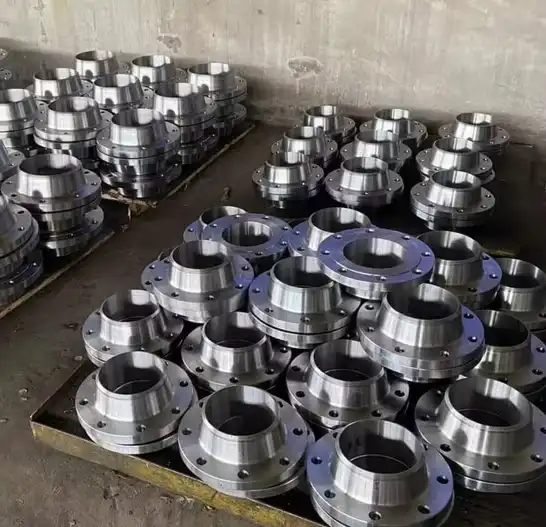
Understanding Carbon Steel and Forged Steel Flanges
Carbon steel forged steel flanges are precision-engineered parts that hold pipes, valves, pumps, and other equipment together in a safe system. Extreme heat and compressive forces are used to shape steel billets during the forging process. This changes the internal grain structure into a dense, directional pattern that follows the shape of the flange.
What Makes Forged Flanges Different?
The chemical makeup usually has between 0.15% and 0.30% carbon, as well as manganese, silicon, and trace elements that affect how strong it is and how well it can be welded. This controlled composition, along with the forging process, gets rid of the internal voids and gas porosity that are common in cast products. As a result, the part can handle sudden changes in temperature and pressure without cracking inside.
At JS Fittings, we make all kinds of forged flanges, from standard weld necks to custom blind flanges, that are made to keep oil, gas, and industrial processing lines structurally sound and free of leaks. We make sure that the quality of our products meets strict international standards.
Industry Standards and Specifications
When making forged flanges, a few important rules are followed:
- ASME/ANSI B16.5: The ASME/ANSI B16.5 standard covers pipe sizes from 1/2" to 24" and lists their measurements, tolerances, and pressure values.
- ASME B16.47 Series A & B: Series A and B of ASME B16.47 deal with large-diameter flanges from 26" to 60".
- DIN / EN 1092-1: EN 1092-1: European metric standards that are used a lot in foreign projects
These rules ensure that all manufacturers adhere to uniform dimensions and pressure containment capabilities. People who work in procurement can be sure that the flanges they specify will work well with the infrastructure that is already in place. Standardisation also makes it easier to check the quality of products because test papers use benchmarks that are known by everyone.
Forged vs Plate Flanges: Technical Comparison and Manufacturing Processes
By understanding the changes in how carbon steel, forged steel flanges, and plate flanges are made, you can see why their performance is so different. Knowing this information helps engineers and purchasing managers choose the right type of flange for the job.
The Forging Process and Its Benefits
Forging is the process of heating steel billets to temperatures typically between 950°C and 1,250°C and then shaping the metal with hydraulic or mechanical pressure. This process makes the internal grain structure smoother so that the metal grain flow follows the contour of the flange with the shape of the flange. This makes the improved fatigue resistance, toughness, and strength even across the flange face, which is very important to keep the flange from bending when the bolts are tightened.
Our CNC cutting centres give the sides of flanges precision serrated or smooth finishes. This makes sure that the gaskets fit perfectly and stops leaks in places with a lot of vacuum or pressure. We keep very close standards for the thickness and alignment of the bolt holes. This way, when your team is out in the field, the flanges will fit perfectly with matching tools, which will save time and money on labour.
Plate Flange Manufacturing and Characteristics
Plasma cutting, waterjet cutting, or laser technology is used to cut carbon-steel forged-steel flange plate flanges directly from sheets of rolled steel. The process of making it is easy: choose a plate of the required thickness, cut out a circle, drill holes for the bolts, and machine the flange face. This method is a quick and cheap way to make flanges with standard sizes.
But rolled steel plates naturally have properties that make them directional. The grain structure is parallel to the direction of rolling, which means that there are possible lower through-thickness mechanical properties that are not parallel to this direction. Plate flanges can contain laminations if the base plate has rolling defects, which are thin layers of steel that did not fully bond during rolling. When there is pressure or heat stress on these laminations, they can open up and propagate under loading and affect structural integrity.
Plate flanges' mechanical properties depend a lot on the quality of the base material. Plate flanges are useful in many situations, but they usually don't hold up as well against impact as forged options. This difference is very important when the temperature is low or when there is shock loading.
Pressure Ratings and Performance Comparison
You can get forged flanges that are available in ASME pressure classes 150, 300, 400, 600, 900, 1500, and 2500 (ASME) and PN6 through PN100 (depending on the flange type and standard) (DIN). Each forged flange is made to meet specific ratings for pressure and temperature. This lets engineers safely choose parts for important structures in chemicals and refineries. Some common types of flanges are the following:
- Weld Neck (WN): For critical service and high-pressure situations that need the most strength
- Slip-On (SO): For easy positioning and lower pressure lines, giving you more options for how to place it.
- Blind Flange (BL): Used to securely seal the end of a piping system or a vessel opening.
- Socket Weld (SW) & Threaded (TH): For high-pressure pipes with small diameters
- Lap Joint (LJ): Used in systems that need to be taken apart often.
Plate flanges are commonly used in lower-pressure applications, although higher-pressure designs are available for certain applications when permitted by the applicable standards. Even though they can be made to withstand moderate pressures, they can't be used in critical high-pressure or high-temperature applications because they don't have a forged grain structure.
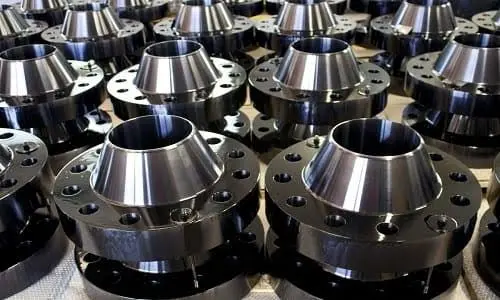
Selecting the Right Flange for Your Application: Forged vs Plate
When deciding between forged and plate flanges, you need to think carefully about the needs of the product, the working conditions, and the expected long-term performance. This part walks procurement professionals through the process of making a choice.
Pressure Class and Application Requirements
The highest working pressure at a certain temperature determines the pressure class. Forged flanges work well in Class 600 and higher because the improved grain structure gives them the strength and fatigue resistance they need. Forged flanges are reliable and reduce the number of unexpected shutdowns in oil and gas facilities that use corrosive fluids at high temperatures.
When the pressure is low, like in cold water systems, low-pressure steam lines, and general utility services, plate flanges work well. When you need dozens or hundreds of flanges for big infrastructure projects with moderate operating conditions, their lower cost becomes very important.
Industry-Specific Use Cases
For wellhead hookups, refinery process units, and pipelines, oil and gas companies always ask for forged flanges. Forged flanges are the best option because they can handle pressure surges during emergency shutdowns and thermal cycling during startup procedures. Forged flanges with precisely polished faces are the only way for petrochemical plants that work with dangerous fluids to make sure they maintain leak-tight sealing.
Forged flanges are used in high-temperature steam systems at power plants to keep materials from breaking down due to heat stress. The fine-grain structure doesn't change shape easily, so the gasket stays compressed for long periods of time.
Plate flanges and AWWA standard flanges are used in low-pressure industrial utilities, HVAC systems, and water treatment plants for cities. When ordered correctly and with enough corrosion protection, they last for decades without any problems and cost a lot less than forged options.
Quality Control and Verification Methods
Verification of the material using spectral analysis to confirm its chemical composition is the first step in quality assurance. Ultrasonic testing finds internal breaks that could make pressure control less effective. Radiographic examination shows small flaws that can't be seen on the surface.
Dimensional inspection checks that the bolt hole spacing, flange width, and face finish meet the requirements of the standard. Before shipping, hydrostatic testing makes sure that the pressure is stable. Our quality management system at JS Fittings is ISO9001-certified, which means that every forged flange we make meets international standards. To make sure of the quality and reliability of our products, we keep up-to-date testing tools like optical emission spectrometers (OES) and ultrasonic flaw detection systems.
With every order, people who work in procurement should ask for EN 10204 3.1 mill test reports. These certificates list heat numbers, chemical analyses, mechanical test results, and details about the heat treatment. This makes it possible to track the goods all the way through the supply chain.
Procurement Insights for Carbon Steel Forged and Plate Flanges
There's more to strategic procurement than just comparing prices. Knowing what your provider can do, how long it will take, and what extra services they offer can have a big effect on the success of your project and the total cost of ownership.
Commercial Considerations and Ordering Strategy
Minimum order amounts depend on the flange type and manufacturer. Standard forged flanges in popular sizes may have lower MOQs, but special designs need larger minimum order quantities to cover the cost of the tools. For standard items, lead times are usually three to six weeks. For large-diameter or special-grade flanges, it can be eight to twelve weeks.
When you order in bulk, you save money because you get volume discounts and better freight costs. When procurement teams plan ahead, they can consolidate orders, which lowers the cost per unit and the cost of shipping. To find the right balance between the costs of keeping inventory and the savings from not having to buy it, you need to carefully look at project timelines and storage space.
Pricing structures are based on how much materials cost, how hard they are to make, and how the market is doing. Forged flanges are very expensive because they need to be made with a lot of energy and machine work. When the needs of the application allow them, plate flanges can save you money.
Supplier Selection and Risk Mitigation
To find reliable suppliers, you need to check their certifications, do factory audits, and look at their performance history. Certified providers show that they are dedicated to quality control systems and following the rules. We have ISO, CE, GOST-R, and qualifications from important energy companies like PETROBRAS, NIOC, and ADNOC as certifications at JS Fittings.
Factory audits show how much can be made, how quality is controlled, and how the business is run. Working directly with manufacturers gives you a better idea of their technical know-how and ability to meet your specific needs. Since 1983, JS Fittings has been manufacturing forged flanges and is now a trusted partner for customers in more than 30 countries around the world.
Performance reviews look at how often deliveries are made on time, how consistent the quality of the products is, and how well problems are solved. Our track record shows that we care about customer satisfaction: over 95% of deliveries are made on time, less than 0.5% of customers complain, and 98% of customers buy from us again.
Value-Added Services and Customisation
When you buy from a factory-direct maker, you can make changes that wholesalers can't. JS Fittings sells products with sizes ranging from DN15 to DN2000, and they also make custom products to fit the needs of each application. Our foreign trade team responds to customer enquiries within one hour and helps with technical questions and quotes.
Some services that add value are faster shipping for urgent needs, consolidated packaging to cut down on handling, and managing logistics around the world. Our AWWA standard flanges are treated with high-grade industrial black lacquer, rust-preventive oil, or hot-dip galvanising to keep them from rusting while they are being shipped by sea or stored in a warehouse. This makes sure they arrive ready to be installed.
Conclusion
In conclusion, when choosing between forged and plate flanges, you need to think about how well they work technically, what the application needs, and your budget. Forged flanges are stronger, don't wear down easily, and keep pressure inside for important jobs in the oil, gas, chemicals, and power generation industries. Their fine-grain structure and precise cutting make sure that the seals don't leak and that they will last for a long time. Plate flanges are a cheap way to solve problems in low-pressure situations where the working conditions stay normal. Procurement experts can make choices that are safer and better value for money when they know about differences in manufacturing, industry standards, and quality verification methods. When you work with experienced makers, you get access to their technical knowledge, the ability to make changes, and full help throughout the supply chain.
FAQ
1. What are the main advantages of forged flanges over plate flanges?
Forged flanges have a finer grain structure that gets rid of internal holes. This makes them more resistant to fatigue and impact. Forging lines up the metal fibres with the shape of the flange, which makes the whole part strong. Because of this, forged flanges are perfect for critical service uses that are subject to high pressure and temperature and where failure could lead to safety issues or expensive downtime.
2. How can I verify flange quality before purchasing?
Ask for EN 10204 3.1-mil test reports that show the chemical makeup, mechanical properties, and heat treatment. Choose either ultrasound or radiographic testing (RT) to find problems inside. Check the surface finish and accuracy of the measurements against the requirements in the specification. Working with approved sellers who follow ISO9001 quality systems is another way to make sure that the quality of your products stays high.
3. When should I specify plate flanges instead of forged flanges?
Plate flanges work well in places where the temperature and pressure are moderate, like cooling water systems, low-pressure steam lines, and general utility services. They save money on large orders where the operating conditions don't warrant the higher cost of forged parts. Carefully look at the needs of the product to make sure that plate flanges offer enough safety margins.
Partner with a Trusted Carbon Steel Forged Steel Flange Manufacturer
Every job at JS Fittings is a chance to use their more than 40 years of experience making high-quality forged flanges that meet the strictest industry standards. Our factory-direct approach guarantees low prices without sacrificing quality, and the fact that we ship over 90 containers and 700 tonnes of flanges every month shows that we can handle projects of any size. Whether you need standard ASME B16.5 weld neck flanges or custom solutions for big diameters, our professional team can help you from the specification stage all the way through delivery. Get in touch with us at admin@jsfittings.com to talk about your Carbon Steel Forged Steel Flange requirements and find out how our certified products, quick service, and global logistics support can help your supply chain.
References
1. American Society of Mechanical Engineers (ASME). "ASME B16.5: Pipe Flanges and Flanged Fittings." New York: ASME International, 2020.
2. American Society for Testing and Materials (ASTM). "ASTM A105/A105M: Standard Specification for Carbon Steel Forgings for Piping Applications." West Conshohocken: ASTM International, 2021.
3. Becht, Charles, IV. "Process Piping: The Complete Guide to ASME B31.3." New York: ASME Press, 2019.
4. European Committee for Standardization. "EN 1092-1: Flanges and Their Joints - Circular Flanges for Pipes, Valves, Fittings and Accessories, PN Designated." Brussels: CEN, 2018.
5. Mohitpour, M., Golshan, H., and Murray, A. "Pipeline Design & Construction: A Practical Approach." Third Edition. New York: ASME Press, 2007.
6. Nayyar, Mohinder L. "Piping Handbook." Eighth Edition. New York: McGraw-Hill Education, 2019.
Send Inquiry
You may like
Related Industry Knowledge
- Custom Heavy Duty Forged Steel Flanges for High-Pressure Systems
- Choosing the Right Size Long Radius Buttweld Elbow for Your Project
- What is FBE Coated Steel Pipe?
- ASME B16.9 Buttweld Reducer Dimensions and Weight Guide
- How thick is the FBE Coated Steel Pipe?
- Slip-On Flange Uses and Applications
- How to Select a Buttweld Reducer for Process Piping?
- What is carbon steel pipe made of?
- Buttweld Tee Manufacturing Guide: Seamless or Welded?
- Does ASME require hydrotesting for a blind flange?