
90 degree buttweld elbow Installation: Best Practices





2026-11-13 10:20:34
Correct 90 degree buttweld elbow installation starts before the first arc is struck. I verify the size, schedule, radius, material grade, and heat number against the drawings, then inspect the bevels and bore for damage. Next, I align the fitting without force, tack it with a qualified welder, and follow the approved welding procedure for every pass. After welding, I complete visual, dimensional, and code-required examinations, then perform the required pressure test before commissioning. Skipping any of these steps can lead to leaks, wall thinning, stress concentration, and rework. The sections below show how I handle each step and what buyers should request from a supplier.
I wrote this guide for piping engineers, EPC contractors, distributors, local installers, and plant teams. An elbow does more than turn the flow. Wrong dimensions, material, or welding practice cause leaks, inspection delays, and costly shutdowns.
Know the 90 Degree Buttweld Elbow Before You Install It
How a Butt Weld Elbow Connects to Pipe
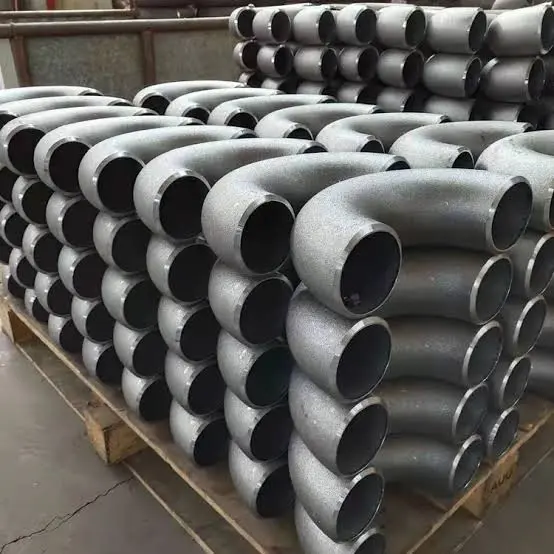
With a 90 degree buttweld elbow, the beveled ends weld straight to the pipe. It is made of steel and is shaped by making it hot press or forge. If you weld something together, you get a solid part that doesn't have any threads or sockets that could leak. And because of this, butt-weld elbows can stand up to more pressure and heat than socket-weld or threaded elbows.A 90-degree buttweld elbow redirects fluid flow perpendicular to the incoming line, providing an optimal configuration for piping orthogonal runs around structural steel frames and equipment headers. When teams need to take things apart, they can still use flanged joints, but they have more nuts, gaskets, and ways for leaks to happen.
Long Radius and Short Radius Choices
The radius changes how the fitting performs in service. The center-to-end dimension of an NPS 4 long-radius (LR) elbow is 1.5 times the nominal pipe size, or 6 inches. The center-to-end dimension of an NPS 4 short-radius (SR) elbow is equal to the nominal pipe size, or 4 inches. There is generally less pressure drop and turbulence through an LR elbow because its curve is more gradual. This makes it suitable for many gas, slurry, high-velocity, erosive, and pump-discharge lines. SR elbows are more compact and can fit into tight spaces, but they generally create greater flow resistance. I choose an LR elbow when there is enough installation space and an SR elbow when space is limited, and the design permits its use.
Where These Elbows Are Used
A 90-degree butt-weld elbow can be found anywhere a line must bend under pressure. Lines that move oil and gas use it to change routes while being under a lot of pressure. This alloy is used in power plants in lines that carry steam and are heated and cooled many times. For use at high temperatures, makers choose types like WP11 or WP22. Steel or stainless steel types are used in chemical, water, food, and drug plants for low-maintenance runs. This joint is part of the pipeline, so it doesn't have the risk of leaks that comes with threaded fittings. I always check the service against the grade before I buy.
Check Dimensions, Material, and Pressure Requirements
Confirm Size, Schedule, and Radius
Before I put any parts together, I look at the order form, the drawing, and the product tag line by line. I look at the NPS, the outside diameter, the wall thickness, the radius, and the distance from the middle to the ends. When the elbow wall fits with a pipe, the inside diameters of the pipes should line up. Butt weld 90-degree elbow schedules—typically SCH 10, SCH 40, SCH 80 up to XXS—are manufactured by JS FITTINGS across sizes from ½" to 48", alongside custom heavy-wall configurations. When adjoining schedules do not match, an internal bore step is created, severely restricting fluid flow and inducing localized stress concentrations that accelerate weld root erosion.
Match Material Grade to Service
The grade is selected based on the fluid, temperature, pressure, and corrosion conditions. ASTM A234 WPB carbon steel elbow is utilized in numerous industrial and process applications. ASTM A403 stainless steel elbows such as WP304L or WP316L can be used for some acidic conditions and corrosive services. However, chlorides can still cause corrosion of vulnerable grades of stainless steel under the correct conditions. Low-carbon stainless steel grades minimize the danger of sensitization during welding. I don't guess; I check the inspection and spec documents that apply. If there is no longitudinal weld seam in the pipe, the elbow can be fabricated from a suitable seamless pipe or other qualified material. I also ask for the mill test certificate (MTC) and match the heat number on the MTC to the heat number stamped on the fitting. Material composition and carbon equivalent, where applicable, may impact welding techniques and preheat needs.
Understand What ASME B16.9 Covers
ASME B16.9 covers the dimensions, tolerances, testing standards, and marks for factory-made wrought buttwelding fittings. By itself it does not prove that the material is OK for the fluid, that the welds will pass inspection or that the system can bear the projected pressure. These questions must also be answered by project requirements, suitable material standards,and process piping codes such as ASME B31.3. ASME B16.25 governs the preparation of butt-welding ends, standardizing a 37.5° ± 2.5° bevel angle with a 1.6 mm root face. While ASME B16.9 establishes dimensional and tolerance baselines, JS FITTINGS manufactures elbows conforming to ASME B16.9, DIN 2605 (EN 10253-2), and JIS B2312 across ASTM A234, ASTM A403, and MSS SP-75 material grades.
Prepare, Align, and Weld the Elbow
Verify Documents and Inspect the Ends
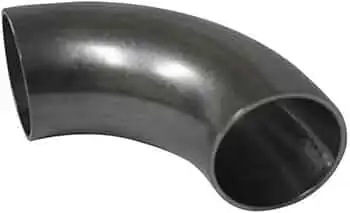
Being ready can help you avoid most field failures. I look over the size, schedule, grade, heat number, manufacturing standard, and certificates of a 90-degree butt-weld elbow before I start to make it. Then I check the pipe ends and bends for dents, cracks, laminations, corrosion, contamination, and strange forms. There shouldn't be any burrs or rough edges on the bevels. Bevels that are broken must be fixed before they can be put together. The metal is porous near the weld because of oil, paint, mill scale, and wetness, so I clean the bevel and the surface next to it until they are just metal. This is what the WPS says to do. Ends that aren't round cause a high-low mismatch, which the welder has to fix and raises the risk of a flaw. A bad fit can be thrown away here for a lot less money than a weld that is well done.
Align and Tack the Joint
Fit-up describes how the components are positioned before welding. Before I tack, I make sure the elbow is oriented correctly in relation to the isometric drawing and that the centerlines of the pipe and elbow are aligned. I also check the center-to-end dimensions and overall fit. Tack welds should be placed and made in accordance with the approved welding procedure. The root gap, bevel angle, and root face should not be based on an arbitrary fixed value. Instead, I follow the approved welding procedure specification (WPS). Some joints may not stay in position when jacks or bolts are used to force them into alignment. This can transfer stress to pumps, equipment nozzles, and supports, potentially affecting their integrity. If the dimensions do not match, I correct the spool or fitting arrangement rather than forcing the weld joint into position.
Control the Welding Process
The WPS, qualified in accordance with ASME Section IX where applicable, tells the welder what type of filler metal to use, whether preheating is required, how much heat to apply, and in what sequence to make the passes. The welder must follow the approved procedure. To obtain a clean root pass, many shops use gas tungsten arc welding (GTAW/TIG). If the WPS permits, they may then use shielded metal arc welding (SMAW) or gas metal arc welding (GMAW) for the fill and cap passes. When I work with stainless steel, I control heat input and use an argon purge inside the pipe to protect the root from oxidation. Whether preheating or post-weld heat treatment is required depends on the material grade, thickness, welding procedure, and applicable code. I also make sure the welding sequence is properly controlled to reduce distortion, and I record each step for traceability.
Inspect, Test, and Avoid Common Installation Problems
Inspect the Finished Weld
You shouldn't use a butt weld 90 degree elbow joint just because it looks good. Visual examination (VT) must first verify that the weld cap and toes are free of cracks, porosity, undercut, angular misalignment, excessive weld reinforcement, or arc strikes. Next, measurements are taken of the elbow's angles, the pipe's slope, where the support is placed, the insulation's space, and how easy it is to clean. What tests need to be done next are set by the rules and the needs of the project. The types of tests that could be used are ultrasound, magnetic particle, dye penetrant, or radiography. One example is ASME B31.3, which sets the test requirements based on the kind of fluid service. Positive material identification (PMI) checks the grade of the metal on lines made of alloy and stainless steel. In every report, I include the heat numbers so that an inspector can easily find the material for each joint.
Test, Clean, and Accept the System
Inspection is followed by pressure testing if required. The ASME B31.3 code normally mandates that the hydrostatic test pressure be not less than 1.5 times the design pressure, with appropriate stress-ratio adjustments, limits, and other requirements of the code. Pneumatic testing involves additional safety precautions. Compressed gas holds far more energy than water. The first thing I do is inspect each joint for leaks throughout the test. After the pressure test, I rinse the line out to eliminate welding debris and other impurities. Additionally, stainless steel systems may need additional cleaning and passivation, depending on project criteria. Next comes official acceptance, and then the quality and engineering teams examine and approve the necessary documentation. The line should be put into operation only after completion of all relevant tests and approvals. It costs more to repair a leak once the line is in service than it does to take the effort to properly test it out beforehand.
Avoid Common Installation Problems
Most installation difficulties can be avoided with the right checks. One of the frequent problems is mix-ups in the warehouse, when a person improperly marks a component or does not compare it with the certificate and purchase order. Wrong schedule or material grade can be introduced into the project. Another drawback is the tight fit-up. The outer wall of an elbow may erode or corrode due to high flow velocity, particles, chlorides, chemical exposure, temperature changes, or cavitation. These circumstances can result in focal wall weakening. The risk may be decreased by the choice of adequate elbow radius, checking wall thickness, and ensuring that the material is appropriate for the fluid. Finally, never claim ASME B16.9 dimensional compliance as evidence that the material or weld quality is acceptable.
Choose a Supplier and Use a Field Checklist
What to Look for in a Supplier
There is a connection between supplier quality, your budget, and your project schedule. I need to know whether the product meets the required ASME and ASTM standards, whether its heat number can be traced, and whether it comes with a mill certificate and inspection records. I also consider safe packaging, export experience, and the supplier's ability to provide timely technical answers. JS FITTINGS has been manufacturing and shipping products for over 30 years. The company operates under an ISO 9001 quality management system and has CE and GOST-R approvals. Spectral analyzers and other inspection equipment are used for material verification and quality control. The company maintains approved supplier qualifications for major global energy operators including ADNOC and Petrobras. Its reported customer complaint rate is below 0.5%, and its repeat-purchase rate is more than 98%. Buyers and EPC contractors can use these indicators to evaluate the supplier's quality management and supply reliability.
When Standard Elbows Are Not Enough
A 90-degree butt-weld elbow from a catalog is enough for most jobs, but some need more. For specialized equipment tie-ins involving non-standard wall thicknesses, proprietary bevel geometries, or custom OEM drawings, engineered custom fabrication becomes necessary.JS FITTINGS has pipe fittings for sizes DN15 to DN2000. They also offer OEM/ODM service, sample production, and small-batch trial sales, so a worker can get one and try it out before buying a bunch of them. Surface coats are things like black paint, varnish, epoxy, and galvanizing. When you ask for a price, your size, wall thickness or schedule, radius, material grade, quantity, standard, inspection needs, location, and target date should all be included. If you give all the necessary details, the pricing process goes faster, and no mistakes happen.
A Field Checklist for Installation Teams
This quality control checklist should be maintained at the shop prefabrication workstation and field tie-in bay, divided into three distinct inspection stages:
- Before installation: Verify size, schedule, radius, material grade, standard, heat number, and certificates against the purchase order and drawings. Check bevel condition, bore cleanliness, alignment, supports, tools, and WPS approval. Reject any fitting with dents, cracks, laminations, or incorrect bevels before it reaches the weld station, and keep the heat number visible for later traceability.
- During welding: Confirm root gap, welder qualification, approved filler metal, preheat, interpass temperature, and heat input before each joint. Clean every pass, control distortion with a balanced sequence, and protect the bore on stainless steel. Record the welder, procedure, and heat numbers so each joint traces back to its material and its weld record.
- After installation: Complete visual and dimensional inspection, then perform the examination the code requires, such as dye penetrant, ultrasonic, or radiographic testing. Pressure test the line, flush it, and dry it where the specification calls for it. Check supports and insulation clearance, and compile the final documents for quality acceptance and engineering approval before commissioning.
Making changes to these steps doesn't cost much, and there is a clear paper trail for inspectors to follow.
Conclusion
To install a 90 degree buttweld elbow correctly, choices must be made from the specifications to the finishing. The service and the drawings must match in terms of radius, wall thickness, schedule, and material grade before the welding can begin. The material standard and pipe code explain what's right and how to plan for pressure, while ASME B16.9 talks about sizes. A clean, well-aligned fit-up, an approved WPS, controlled heat input, and bore protection can all help make sound welds that don't need to be stressed too much. The result is proven after a visual, dimensional, and code-required inspection and pressure testing. Checking documents stops grade and plan mistakes that lead to a lot of failures. Leaks, redos, and shutdown time are less likely to happen with these steps. They also show why clear paperwork and a list of things to do are important for every project.
FAQ
1. What does ASME B16.9 cover?
For parts that are wrought and made in a workshop, it talks about the sizes, standards, and markings that need to be used. There are rules about what materials and forces must be used in the pipe code, the project standards, and the ASTM recommendations.
2. Should I choose a long radius or short radius elbow?
For less erosion and pressure drop, pick a radius that is long if you have the space. When you have no other choice, use a small radius.
3. Can I join Schedule 40 and Schedule 80 components?
It is possible, but there may be an internal or external mismatch because the wall thicknesses are different. The elbow and pipe should be selected to match where possible. Otherwise, follow the applicable code, engineering requirements, and WPS for the transition.
4. Which documents should I request?
Make sure you have mill certificates, compatibility papers, inspection reports, and PMI or NDE records ready for when the project needs them. Verify that the certified heat numbers on the MTR physically match the permanent markings stamped on each fitting.
5. What do I send for a custom quote?
Send where it is, when it needs to be done, the grade of the material, the amount, the standard, the inspection standards, the size, the wall thickness or schedule, the radius, and the quantity.
Request a 90 Degree Buttweld Elbow Quote from JS FITTINGS
JS FITTINGS, a supplier of 90 degree buttweld elbow with more than 30 years of production and shipping experience, can receive your designs and specifications. We have carbon steel elbows that are ASTM A234 and stainless steel elbows that are ASTM A403, with ASME B16.9 dimensions. You can choose from SCH 10, 40, and 80 sizes, or you can have them made to order. You can email admin@jsfittings.com to find out more. Someone from our team will get back to you in an hour.
References
1. ASME B16.9, Factory-Made Wrought Buttwelding Fittings, 2018
2. ASME B16.25, Buttwelding Ends, 2017
3. ASME B31.3, Process Piping, 2022
4. ASTM A234/A234M, Standard Specification for Piping Fittings of Wrought Carbon Steel and Alloy Steel for Moderate and High Temperature Service, 2019
5. ASTM A403/A403M, Standard Specification for Wrought Austenitic Stainless Steel Piping Fittings, 2016
6. ASME Boiler and Pressure Vessel Code, Section IX: Welding, Brazing, and Fusing Qualifications, 2023
Send Inquiry
You may like
Related Industry Knowledge
- What Is Carbon Steel Welded Pipe and How Is It Made?
- ASTM A234 WPB Buttweld Reducer for Industrial Piping
- Best Buttweld Tee Design for Refinery and Petrochemical Lines
- 3D to 20D Radius Buttweld Bend: Industry Applications
- Buttweld Bend for Oil & Gas Pipelines: Material & Specs
- How to Inspect Buttweld Elbow Quality Before Installation?
- Sourcing Custom Steel Flange: A Buyer’s Guide to Working with a Manufacturer
- ASTM A105 Weld Neck Flange: Complete Guide
- Choosing the Right Size Long Radius Buttweld Elbow for Your Project
- What ANSI Pipe Flanges Are Commonly Applied Today?